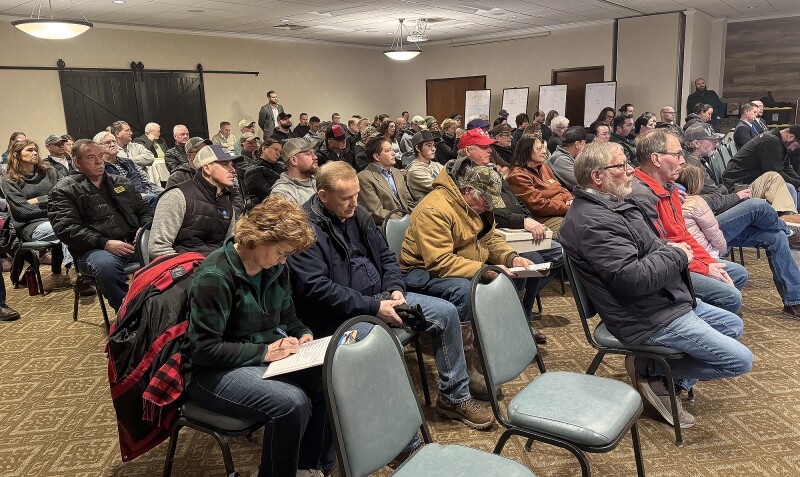
Land and property owners expressed significant concerns regarding the JETx project during a public hearing held on January 16, 2024, by the North Dakota Public Service Commission (PSC). The attendees raised issues related to potential environmental and health impacts, a decrease in property values, and the adequacy of public input in the project’s planning process.
Approximately 100 individuals attended this hearing at the Baymont by Wyndham Jamestown Conference Center & Water Park, marking the final session of three public hearings conducted in the region. Earlier hearings took place in Edgeley and Ellendale, allowing residents to voice their opinions and contribute to the PSC’s official record.
The PSC is tasked with evaluating several critical aspects of the JETx project. This includes ensuring that the proposed location minimizes adverse effects on both the environment and local residents, assessing compatibility with environmental preservation, and confirming that construction and maintenance practices will mitigate negative impacts while maintaining reliable energy systems.
Developed in response to a request from the regional power grid operator, Midcontinent Independent System Operators (MISO), the JETx project aims to enhance power grid reliability across North Dakota and the broader Midwest. MISO oversees the power grid for a 15-state region and parts of Manitoba, Canada. The project encompasses a new double circuit 345 kilovolt transmission line that will span approximately 92 miles, connecting Otter Tail Power Company’s substation near Jamestown to Montana-Dakota Utility’s substation near Ellendale. The estimated cost of the JETx project, including substation expansions, is projected to be around $406 million.
Jason Weiers, manager of transmission policy and contracts for Otter Tail Power, explained that the JETx project would create a transmission loop to improve the reliability and economic delivery of energy in the region. Initially, the transmission line will be constructed with one circuit, with certain areas designed to support double circuits to minimize environmental impacts.
Support for the JETx project was voiced by Dan Inman, senior vice president of power delivery and chief information and technology officer for Minnkota Power Cooperative. Inman emphasized that the project not only benefits North Dakota residents but also enhances the electric grid’s resilience and efficiency across the broader region. He highlighted the need for improved reliability, particularly in light of severe weather events that previously caused extended power outages in the Jamestown area.
In November 2024, the PSC granted Otter Tail Power and MDU certificates of public convenience and necessity for the JETx project. However, following a request from a group of landowners and township residents in June 2025, the PSC denied a reconsideration of its approval, despite claims that the project had been unlawfully authorized. The applicants are now seeking a route permit from the PSC.
The project aims to address reliability issues on the constrained 230 kV transmission system in eastern North Dakota and parts of South Dakota and west-central Minnesota. Weiers noted that past severe weather events left Jamestown reliant on limited transmission capabilities, which the JETx project seeks to alleviate.
Construction of the JETx project is slated to begin in the third quarter of 2026, with completion and energization expected by the fourth quarter of 2028. Final reclamation efforts are scheduled for 2029. Weiers assured that all necessary land rights and easements would be secured prior to the commencement of construction.
The legislative backdrop includes House Bill 1258, enacted during the 2025 legislative session, which grants the PSC the authority to override local zoning ordinances that conflict with state approval for electric transmission projects. This has prompted further concerns among landowners, particularly regarding setback distances between high-voltage transmission lines and occupied dwellings.
Local zoning ordinances in Stutsman County stipulate a setback of 1,000 feet from occupied homes, while the PSC standard is currently set at 500 feet. Concerns were raised by residents, including Levi Taylor, a Stutsman County Commission member, who questioned why project applicants had not sought conditional use permits from the county, especially given the recent changes to zoning ordinances.
Community members, including Alana Wagner from rural Edgeley, voiced their frustrations regarding the perceived retroactive nature of House Bill 1258, arguing that it undermines local property rights without substantiating the necessity of the JETx project.
Public Service Commissioner Jill Kringstad noted that project applicants had testified that the current route adheres to the 1,000-foot setback established by the Stutsman County Commission.
Other residents, such as Leon Westerhausen and Steve Schwarzrock, shared their concerns about the proximity of the transmission line to their homes and the lack of adequate communication regarding the project. Many expressed dissatisfaction with the outreach efforts, claiming they received minimal information about the project’s implications.
In response to these concerns, Weiers stated that a public outreach program was implemented to inform landowners and stakeholders about the JETx project. This included letters sent to counties and townships, soliciting feedback on the transmission line route and providing contact information for project inquiries.
The PSC plans to collaborate with its advisory staff to discuss the project further, culminating in a formal decision based on the discussions held during the hearings. As the JETx project moves forward, the balance between enhancing regional power reliability and addressing community concerns will remain a critical focus for both the PSC and the project developers.