
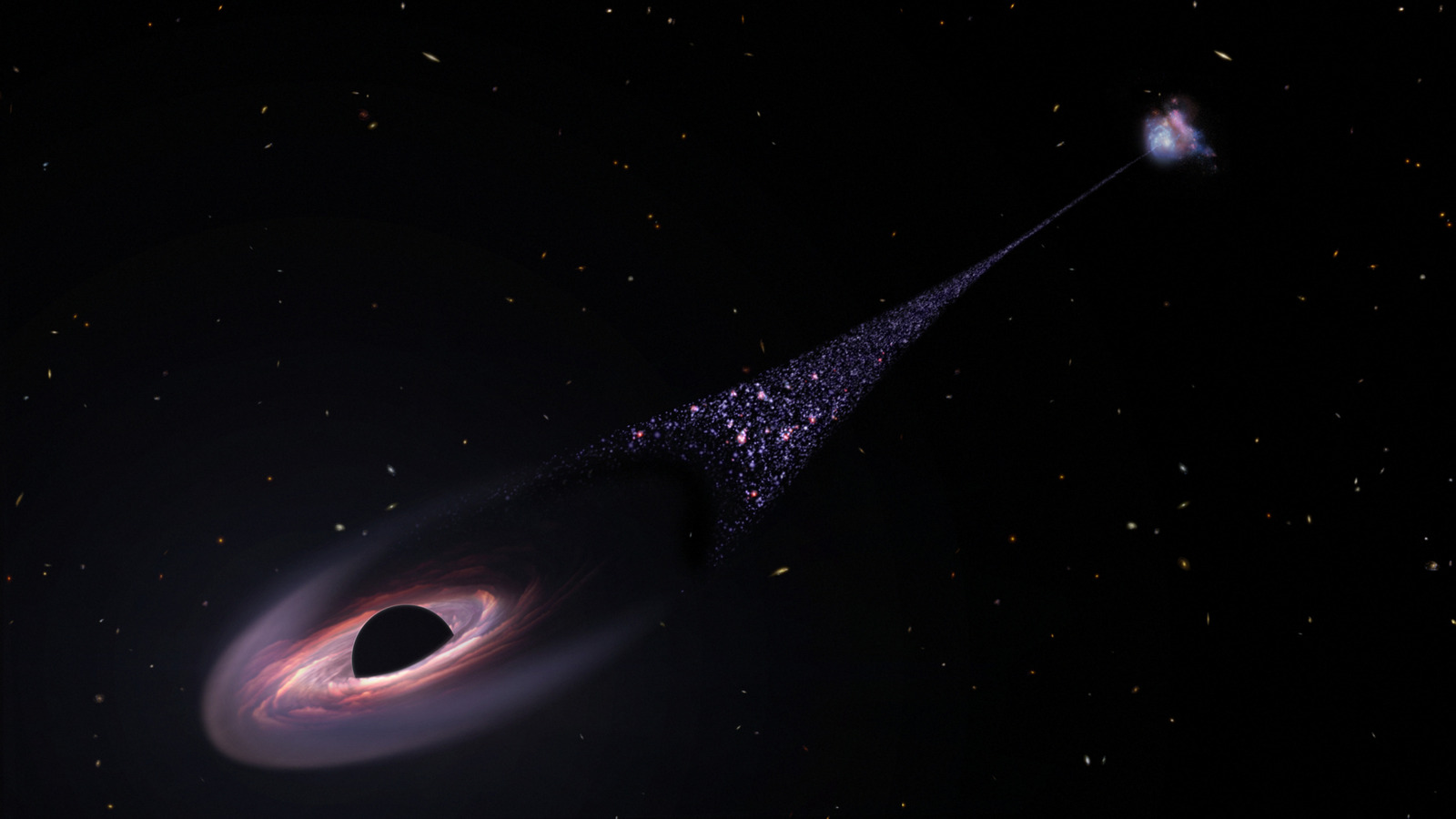
Scientists have made a groundbreaking discovery by confirming the existence of the first-ever “runaway” supermassive black hole (SMBH). This extraordinary astronomical object is estimated to have the mass of 20 million suns and is traveling away from its original galaxy at an astonishing speed of 2.2 million mph. The findings were announced by a research team led by Pieter van Dokkum from Yale University in a paper titled “JWST Confirmation of a Runaway Supermassive Black Hole via its Supersonic Bow Shock,” which was uploaded to arXiv in December 2025.
The team initially identified the potential runaway black hole in 2023 while analyzing an image captured by the Hubble Space Telescope. A thin line connecting to the center of a galaxy caught their attention, prompting further investigation. In an interview with Live Science, Van Dokkum explained that this line indicated the presence of “a very massive black hole that was ejected from the galaxy, leaving a trail of gas and newly formed stars in its wake.” The team’s preliminary findings were published in The Astrophysical Journal Letters that same year, but confirmation required additional study.
To validate their hypothesis, the researchers turned to the James Webb Space Telescope (JWST), which has provided some of the most detailed images of the universe. The JWST’s advanced imaging capabilities revealed a bow shock at the front of the SMBH, effectively confirming that the black hole is indeed escaping its galaxy at a rapid pace.
Understanding the Mechanics of a Runaway Black Hole
Supermassive black holes present one of the many unresolved mysteries in astrophysics. While scientists are confident that these colossal entities exist and that most galaxies harbor one, the precise mechanisms behind their formation and rapid growth remain elusive. The December 2025 paper posits that this particular SMBH was set on an escape trajectory due to a “velocity kick,” likely resulting from either gravitational-wave recoil or a three-body interaction. Van Dokkum suggests that gravitational-wave recoil is the more probable cause.
The concept of velocity kicks arises when two or more supermassive black holes become closely aligned. The intense gravitational forces exerted by each black hole can alter their orbits, leading to one being propelled out of its galaxy. In the case of the newly confirmed runaway black hole, the researchers speculate that it underwent such a kick, enabling its rapid exit from the galaxy.
Potential for More Runaway Black Holes
This discovery raises intriguing questions about the existence of similar runaway black holes elsewhere in the universe. The research team identified several other potential candidates, including a massive black hole located in the dwarf galaxy MaNGA 12772-12704, which is offset from the galaxy’s center by about 1 kiloparsec. This finding was first reported in a short communication published in Volume 70, Issue 21 of Science Bulletin.
As of now, Van Dokkum’s team stands as the only group to have confirmed a runaway SMBH, though the findings are pending peer review. The implications of this discovery extend beyond mere academic curiosity; they challenge and enhance our understanding of black hole dynamics and their role in the evolution of galaxies.
The research not only sheds light on the peculiarities of supermassive black holes but also opens new avenues for exploration in the field of astrophysics. As further studies are conducted, scientists hope to unravel the complexities surrounding these enigmatic cosmic phenomena.


