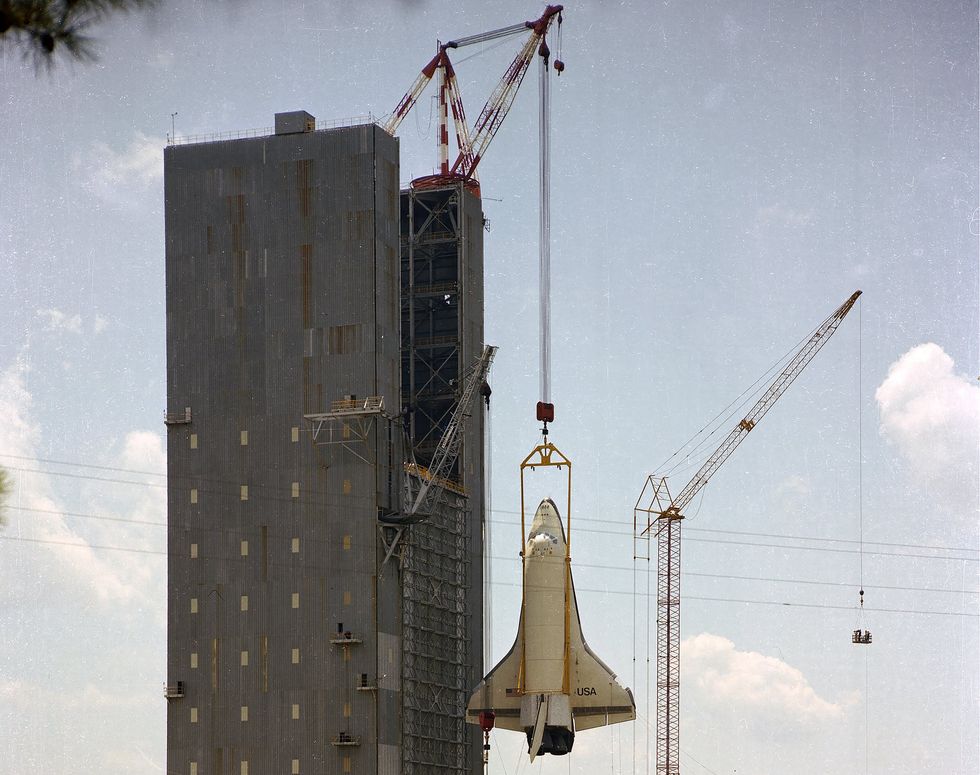
On January 10, 2024, NASA marked the end of an era with the demolition of two iconic test stands at the Marshall Space Flight Center in Huntsville, Alabama. The Dynamic Test Stand and the Propulsion and Structural Test Facility, commonly known as the T-tower, were brought down in controlled implosions, signaling the conclusion of their decades-long contribution to U.S. space exploration. These structures not only facilitated groundbreaking rocket technology but also served as vital test sites for human spaceflight.
The Legacy of the T-tower and Dynamic Test Stand
Constructed in the late 1950s and early 1960s, both facilities witnessed significant milestones in the space race. The T-tower, built in 1957 by the Army Ballistic Missile Agency, stood at over 50 meters tall. It was designed for static testing, where rockets were fired at full power while secured in place. Engineers utilized this facility to test components of the Saturn family of launch vehicles under the supervision of Wernher von Braun, including the powerful F-1 engines that eventually propelled the Apollo missions.
The T-tower was not only instrumental for Apollo but also played a crucial role in testing the Space Shuttle’s solid rocket boosters before its retirement in the 1990s.
In contrast, the Dynamic Test Stand, completed in 1964 and towering at over 105 meters, became the tallest man-made structure in North Alabama. This facility allowed engineers to subject fully assembled Saturn V rockets to the same mechanical stresses and vibrations that would be experienced during actual launches. The testing environment replicated launch conditions without leaving the ground, ensuring the reliability of rockets that were too powerful and costly to risk failures at the launchpad.
Its significance extended beyond the Apollo missions. In 1978, the Dynamic Test Stand was the first location to integrate all Space Shuttle components, including the orbiter, external fuel tank, and solid rocket boosters, into a complete system. Its last function came in the early 2000s when it served as a drop tower for microgravity experiments.
A Bittersweet Demolition and Preservation Efforts
Both test stands were designated as National Historic Landmarks in 1985, recognizing their irreplaceable contributions to space exploration. The decision to demolish them was difficult yet necessary, as ongoing maintenance of aging facilities diverted resources from NASA’s current missions. Marshall Space Flight Center is in the process of removing 19 obsolete structures as part of a broader transformation aimed at creating a modern, interconnected facility for future endeavors.
“It is hard to let them go, but they’ve earned their retirement,” said Rae Ann Meyer, acting director of Marshall. “The people who built and managed these facilities are the most important part of their legacy.”
To honor this legacy, NASA has taken steps to preserve the history of these iconic structures. Detailed architectural drawings, photographs, and written histories have been archived at the Library of Congress. Additionally, Auburn University has utilized advanced technology to create high-resolution digital models using LiDAR and 360-degree photography, capturing the test stands in intricate detail before their demolition. These virtual archives will ensure that future generations can appreciate the monumental engineering achievements represented by these structures, even after their physical presence has been removed.
As NASA embarks on new missions, the memories and accomplishments associated with the T-tower and Dynamic Test Stand will remain a testament to the pioneering spirit of human space exploration.