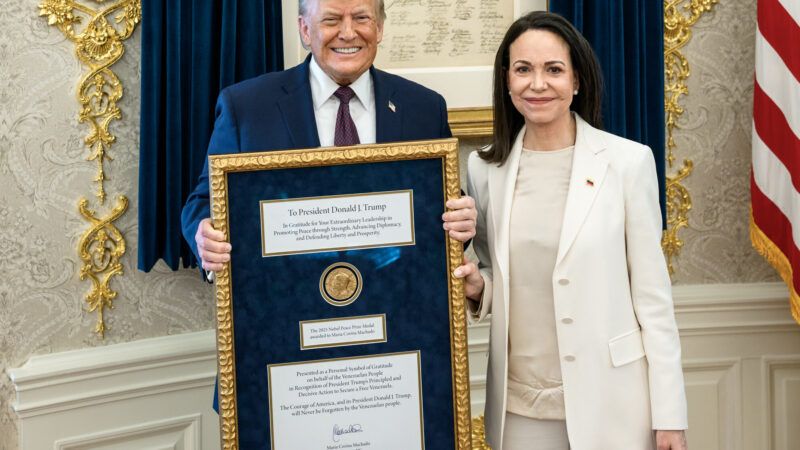
The political landscape in Venezuela took an unexpected turn when María Corina Machado, the country’s opposition leader and the latest recipient of the Nobel Peace Prize, presented her award to former President Donald Trump during a meeting at the White House. This gesture, intended to foster influence amid Venezuela’s precarious transition, raised eyebrows given the Nobel Committee’s strict rules regarding the award’s transferability.
Machado’s decision comes at a crucial moment for Venezuela, where the political climate remains unstable following the ousting of long-time leader Nicolás Maduro. In her view, aligning with Trump could enhance the opposition’s chances to steer the nation towards improved governance. The meeting occurred on September 2023, during which Trump expressed gratitude for the gesture, calling Machado a “wonderful woman” who has endured significant challenges.
Political Ramifications of the Gesture
Trump has often claimed credit for various diplomatic successes, including his involvement in negotiations between nations such as Armenia and Azerbaijan, as well as the ongoing tensions between India and Pakistan. In a speech at the United Nations, he criticized its effectiveness, suggesting that the organization fails to act decisively in global conflicts. He has made assertions about having ended several wars, further solidifying his foreign policy narrative.
While Trump hailed Machado’s gesture as one of “mutual respect,” the political implications of this exchange are complex. The former President has faced criticism for his administration’s military actions and sanctions against Venezuela, which some argue have exacerbated the humanitarian crisis. Machado’s overture to Trump might signal an attempt to leverage his influence to facilitate a transition away from Maduro’s regime.
Delcy Rodríguez, the current Vice President under Maduro, has been characterized as corrupt, heightening the stakes for Machado’s opposition party, which claims a legitimate mandate to govern. As tensions continue to mount in Venezuela, the international community is closely monitoring the situation, particularly the United States’ role in shaping the country’s future.
Global Reactions and Perspectives
Analysts have varied opinions on Machado’s approach. Some view her actions as politically astute, while others criticize her for compromising her stance. Marianne Dahl, research director at the Peace Research Institute Oslo, remarked that it is easy to critique Machado from afar, suggesting that her efforts might be strategically necessary given the circumstances.
The meeting and Machado’s symbolic gesture could have lasting repercussions, not just for Venezuela but also for broader U.S.-Latin American relations. As domestic and international observers digest this development, questions about the future of Venezuelan governance and the potential for a new political order remain central to the ongoing narrative.
With the stakes high and the path forward unclear, the actions of both Machado and Trump will likely influence the trajectory of Venezuelan politics for years to come. The world watches closely as the struggle for power and governance unfolds in this South American nation.