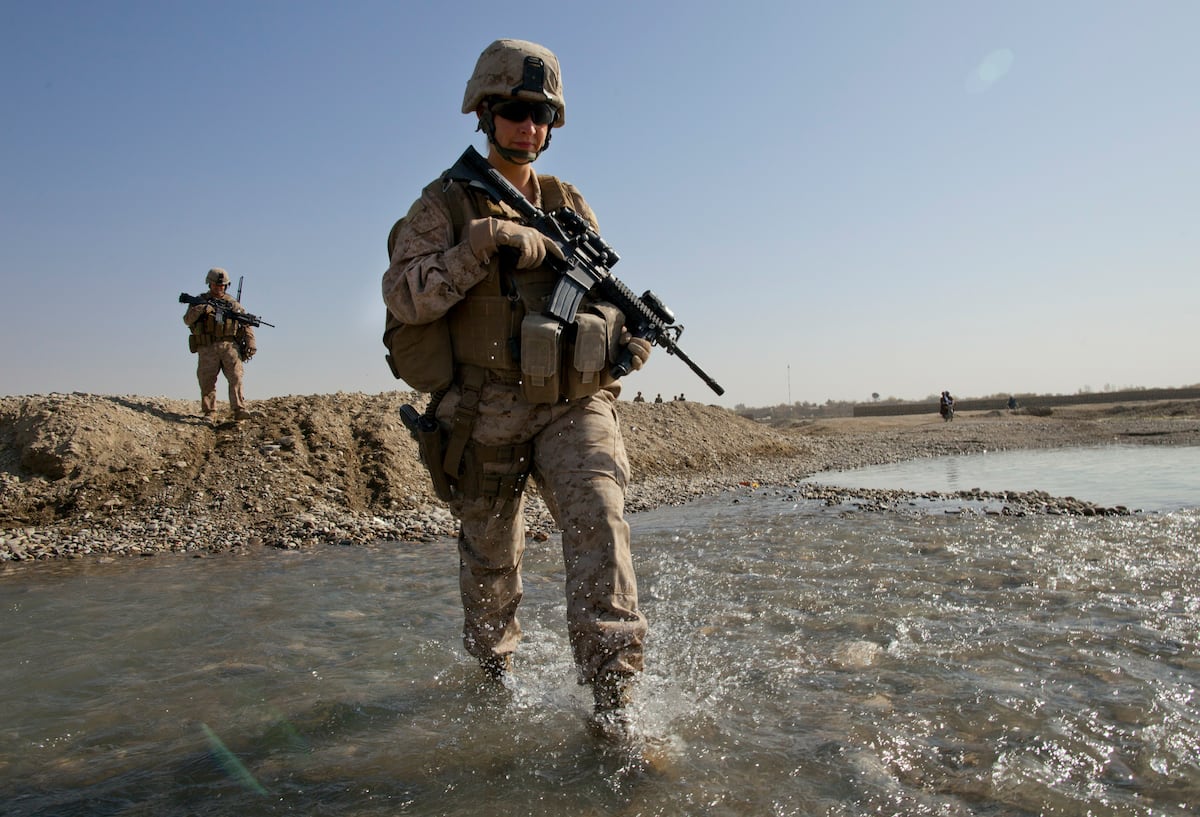
At least 154 women have earned the prestigious Ranger tab from the U.S. Army, a significant achievement that underscores their capabilities in combat roles. As of early 2025, the Army emphasized that Ranger School is designed to test soldiers’ limits through extreme physical challenges. Yet, the Pentagon’s recent announcement of a formal review of the inclusion of women in combat positions has reignited a contentious discussion that many thought had been resolved.
This review comes over a decade after the Department of Defense opened Ranger School and all combat jobs to women in 2015, a move that marked a pivotal shift within the military. The Pentagon stated that the study aims to assess the military’s ability to meet rigorous demands. In a statement to Military Times, Defense Secretary Pete Hegseth asserted, “We will not compromise standards to satisfy quotas or an ideological agenda – that is common sense.”
Despite this, critics argue that female soldiers have already demonstrated their effectiveness in elite combat roles. According to data collected by the Women in the Service Coalition, there are currently 4,594 female soldiers deployed in the Army’s conventional combat units. The Pentagon, however, did not comment on these figures.
Questions arise regarding the motives behind the review. Many women in the military suspect that this initiative serves to reinforce a predetermined conclusion—that women do not belong in the infantry.
“The only reason to conduct a new study is if you want a different outcome,”
said Sue Fulton, executive director of the Women in the Service Coalition, in an interview with Military Times. She expressed concern that the intent is to marginalize women, especially given Hegseth’s past statements against integrating women into frontline combat roles.
In a November 2024 podcast, Hegseth openly criticized the participation of women in combat, referencing a Marine Corps report that suggested all-male units outperformed mixed-gender units during a 2015 infantry integration test. A subsequent study released five years later indicated that the Marine Corps remained an outlier compared to other branches, with women making up the smallest share of its forces.
During his confirmation hearing, Hegseth moderated his stance, saying, “if we have the right standard and women meet that standard, roger, let’s go.” Nevertheless, his remarks at a high-profile speech in September 2025 raised alarm among some female troops. He stated that “every requirement” for combat troops would revert to “the highest male standard only.”
Two women who graduated from Ranger School and served in combat, both of whom wish to remain unnamed, expressed their dismay at the review. One of them, identified as Emily, remarked, “It is a slap in the face to all the accomplishments of the women who have been in the infantry.” She emphasized that the standards at Ranger School were not lowered for female candidates, stating, “I took the same physical fitness test as the men. We earned our spots.”
Following the opening of all combat roles to women, the Army implemented gender-neutral physical tests. Hegseth expanded this framework in 2025 to include all combat arms positions. Another graduate, Olivia, who has deployed to multiple war zones as a field artillery officer, highlighted the realities of combat. “Combat is an equalizer,” she stated. “When people are shooting at you or you’re taking incoming rocket attacks, all those kinds of divisions disappear.”
Olivia further insisted that the distinctions between male and female soldiers dissolve in the face of danger. “It matters that we are all a part of the same fighting force and we all have the same goal in mind,” she said. Her experience at Ranger School, she noted, was one of equality, stating, “The standard has always been the same.”
As the Pentagon moves forward with its review, the voices of women like Emily and Olivia reflect a growing insistence on recognition of their contributions and capabilities in combat. The outcome of this evaluation may significantly impact the future of female representation in the U.S. military’s combat roles, a debate that continues to resonate within the ranks.