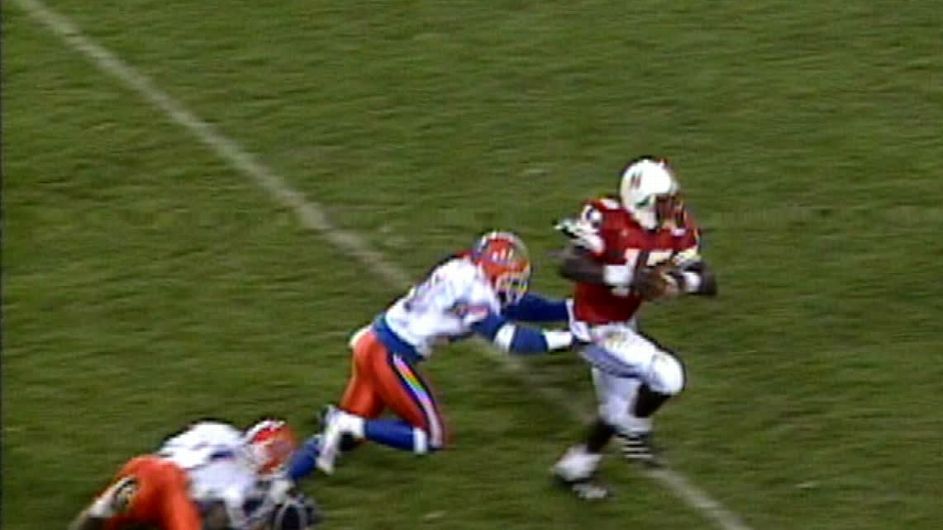
Tommie Frazier’s remarkable 75-yard touchdown run during the 1995 national championship against the Florida Gators continues to resonate in college football history. This moment defined not only Frazier’s career but also solidified the Nebraska Cornhuskers’ dominance in the sport. Nebraska’s victory, a decisive 62-24 rout, showcased Frazier’s exceptional skill and tenacity, as he evaded multiple tackles from nine defenders on what became known as the “32 option” play.
The play unfolded late in the third quarter, with Frazier expertly navigating the field. After initially evading two tackle attempts, he broke free from a trio of defenders, including linebacker Ben Hanks and safety Lawrence Wright. The play left an indelible mark on college football, as Coach Tom Osborne remarked, “That was the most impressive one I can remember.”
Thirty years later, this defining moment is still celebrated, underscoring Frazier’s legacy as one of college football’s most prolific option quarterbacks. The 1995 Huskers, under Osborne’s leadership, averaged an astonishing 52.4 points per game and boasted a remarkable rushing average of 400 yards per game, leading to their second consecutive national championship. The team’s average victory margin was nearly 31 points, reflecting their dominance over opponents, including four teams ranked in the AP Top 10.
Frazier’s journey began in Bradenton, Florida, where he grew up as the fifth of six siblings. His early experiences playing alongside older brothers instilled a toughness in him that translated into his college career. When he arrived in Lincoln in 1992, he quickly made history as Nebraska’s first true freshman starting quarterback. Frazier excelled in Osborne’s triple-option offense, demonstrating remarkable poise and decision-making.
By 1994, Frazier had firmly established himself as a leader within the team. His leadership style was direct; he sought respect over popularity. “My job wasn’t to be the most liked. I wanted to be the most respected,” he stated. His competitive nature was evident when he challenged older teammates, motivating them to elevate their performance.
Yet, Frazier’s career faced a significant health challenge when he was diagnosed with blood clots, which sidelined him during the 1994 season. After a successful recovery, he returned to lead the team in the Orange Bowl, where he played a pivotal role in securing Nebraska’s first national title under Osborne.
The 1995 season saw Nebraska continue its dominant streak, culminating in a national championship matchup against Florida. The Gators, led by coach Steve Spurrier, were known for their high-powered passing game, but Frazier and the Cornhuskers were undeterred. By halftime, Nebraska held a commanding 35-10 lead, dominating both offensively and defensively.
When the game reached its climax, Frazier’s signature run became the highlight, as he broke through tackle after tackle to score. On the broadcast, commentator Jim Nantz famously exclaimed, “How many tackles can one man break!?” Frazier’s performance that day included a career-high 199 rushing yards, solidifying his place in college football history.
Despite his success on the field, Frazier’s professional football career did not unfold as he had hoped. After a brief attempt to join the Canadian Football League and subsequent health issues, he ultimately retired from football. In the years following, he was diagnosed with Crohn’s disease, a condition that would affect his life significantly.
In 2013, Frazier was honored with induction into the College Football Hall of Fame, a fitting recognition of his impact on the sport. Although he never played in the NFL, his legacy within college football was already firmly established. Today, Frazier is involved in community work, running Novel Care, an organization that supports individuals with intellectual disabilities and brain injuries, helping them live independently.
Reflecting on his time at Nebraska, Frazier acknowledges the lasting impact of his iconic run. “To me, it was just another play,” he says. Yet, he understands that this moment encapsulates an era when Nebraska dominated college football, led by a quarterback who refused to go down. As fans continue to celebrate his legacy, Frazier remains a symbol of resilience and excellence in the sport.