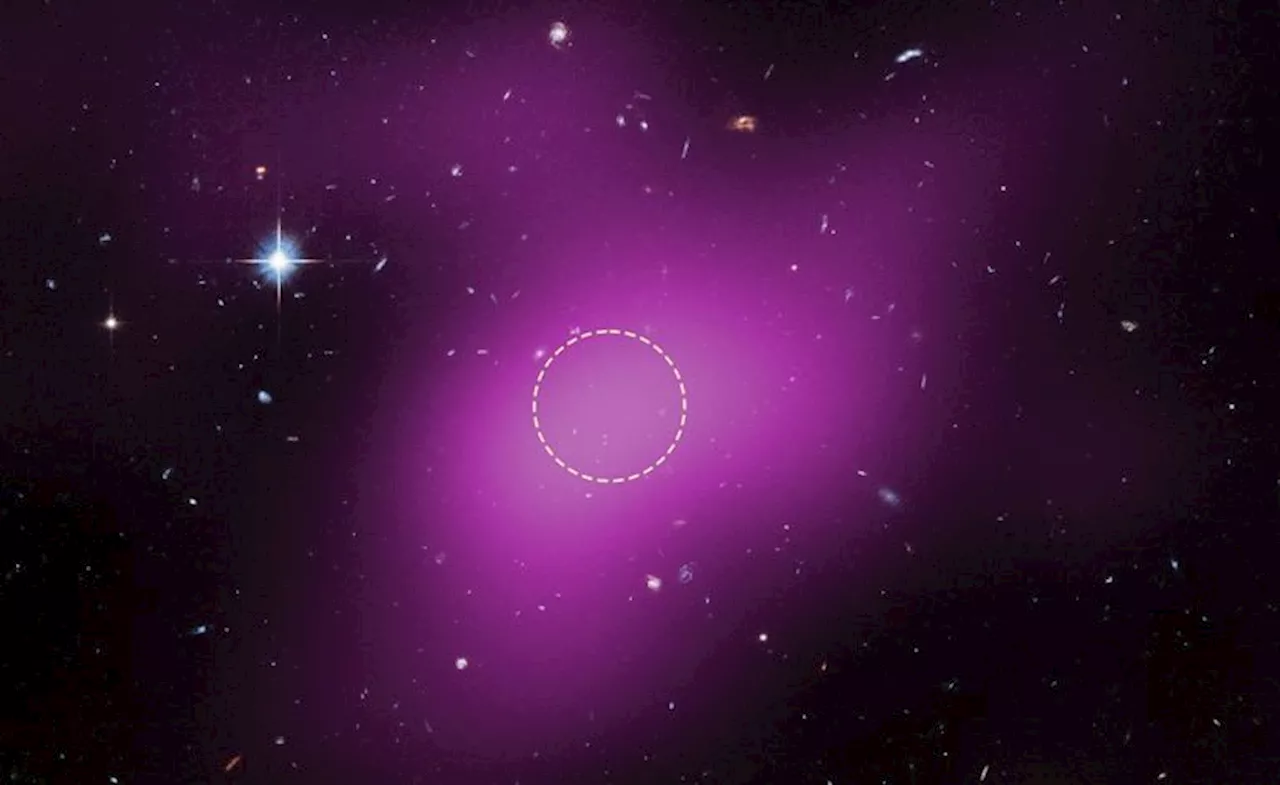
NASA’s Hubble Space Telescope has identified a unique astronomical object known as Cloud 9, which may represent a “failed” galaxy. Located approximately 14 million light-years from Earth, near the spiral galaxy Messier 94, this cloud comprises gas and dark matter but contains no stars, rendering it nearly invisible in optical light.
“This is a tale of a failed galaxy,” stated Alejandro Benitez-Llambay, principal investigator from the University of Milano-Bicocca. He emphasized that the absence of stars supports the theory that Cloud 9 is a primordial object that has not yet, or may never, emit starlight. This discovery presents a significant challenge to traditional theories regarding galaxy formation.
Hubble’s findings reveal a faint concentration of gas, with observations indicating that Cloud 9 is predominantly made up of dark matter. Dark matter, an elusive substance that constitutes much of the universe’s mass, plays a critical role in shaping the cosmos. The combination of these characteristics provides compelling evidence for a type of object long theorized by astronomers, termed a Reionization-Limited H I Cloud (RELHIC).
According to NASA, in the early universe, specific dark matter halos were capable of accumulating gas but did not ignite star formation. Consequently, these conditions led to the creation of rare, starless relics that have largely evaded detection until now. The discovery of Cloud 9 not only confirms a key prediction of cosmological models but also offers a rare glimpse into the early stages of galaxy formation—or, in this case, the failure to form.
The significance of this finding lies in its potential to reshape our understanding of how galaxies develop. Cloud 9 serves as a testament to the complex processes governing the universe’s evolution. As astronomers continue to explore this intriguing cloud, further insights may emerge regarding the mechanisms that lead to successful or failed galaxy formation.
This discovery aligns with ongoing trends in astronomy, where advancements in technology and observational techniques are revealing previously unobservable cosmic phenomena. The implications of Cloud 9 extend beyond mere curiosity; they could potentially inform future studies of galaxy evolution and the fundamental nature of the universe.
In conclusion, the identification of Cloud 9 by the Hubble Space Telescope marks a groundbreaking moment in the field of astronomy. By challenging established notions of galaxy formation, this starless cloud provides a unique opportunity for scientists to deepen their understanding of the cosmos.