A team of astronomers has identified a new celestial phenomenon, dubbed Cloud-9, which represents a unique type of dark matter cloud that failed to form stars. Located approximately 2,000 light-years from Earth, this ancient remnant offers insight into the processes of galaxy formation and the role of dark matter in the universe. The discovery highlights the complexities of cosmic evolution and the conditions necessary for star formation.
Understanding Cloud-9
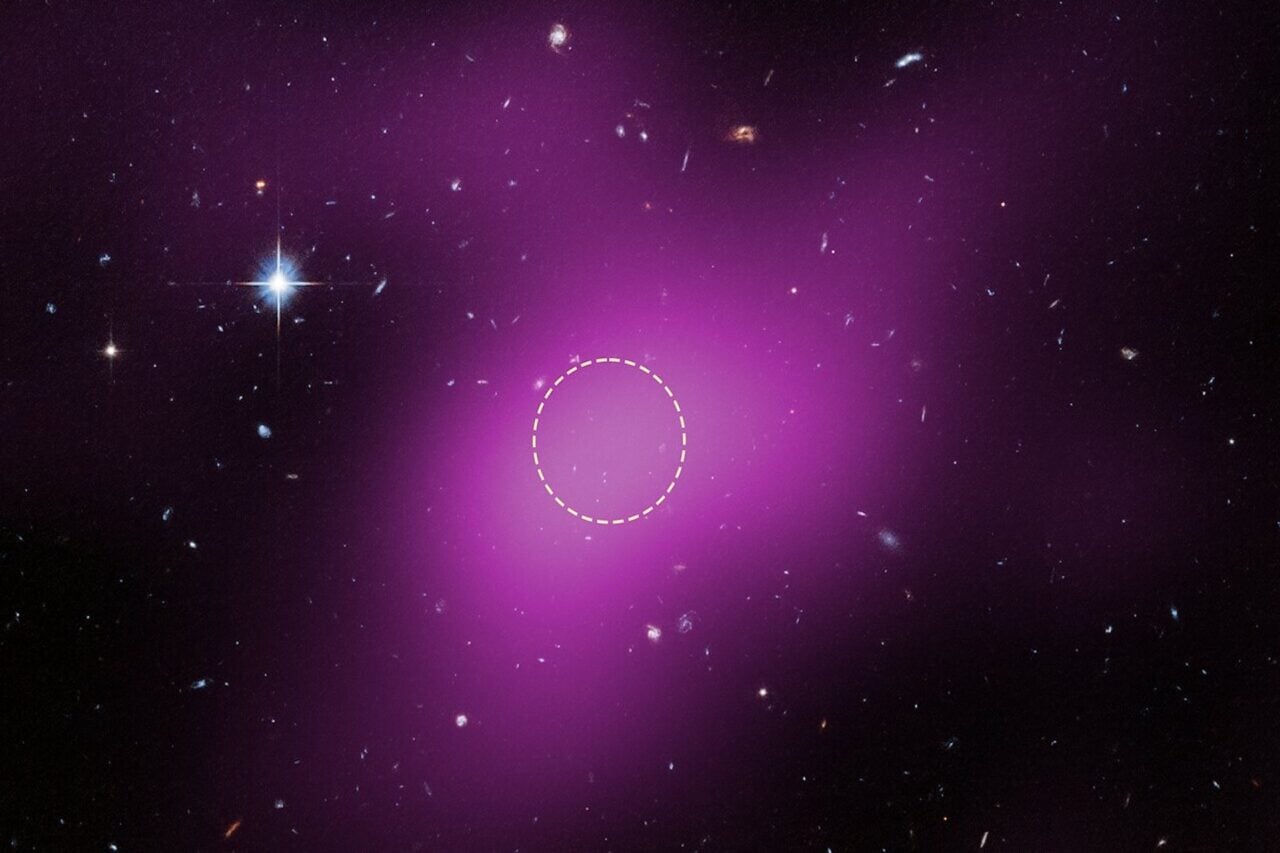
Cloud-9 is a starless dark matter cloud rich in gas, described by Alejandro Benitez-Llambay, an astrophysicist at Milano-Bicocca University, as “a tale of a failed galaxy.” This cosmic object does not contain stars, making it a fascinating example of a primordial building block that never developed into a full-fledged galaxy. According to Benitez-Llambay, “In science, we usually learn more from the failures than from the successes.” The absence of stars serves as critical evidence for scientists studying early galaxy formation.
The research team utilized the Hubble Space Telescope to examine this dark matter cloud, confirming its lack of star formation through the telescope’s Advanced Camera for Surveys. Cloud-9 is the ninth gas cloud identified on the outskirts of the nearby spiral galaxy, Messier 94, and its compact, spherical structure sets it apart from other clouds in the vicinity.
Revealing Dark Matter’s Role
Cloud-9’s core is composed of neutral hydrogen, extending across 4,900 light-years. Remarkably, it contains gas approximately 1 million times the mass of the Sun, while the entire cloud has a mass about 5 billion times that of the Sun. Researchers suspect that dark matter dominates Cloud-9, as the pressure from the neutral hydrogen gas seems to counterbalance the cloud’s gravitational forces.
“This cloud is a window into the dark Universe,” stated Andrew Fox, an astronomer at the Space Telescope Science Institute and co-author of the study. He emphasized the significance of this discovery, noting, “Most of the mass in the universe is expected to be dark matter, but it’s difficult to detect because it doesn’t emit light.” Cloud-9 provides a rare glimpse into a dark-matter-dominated environment, enhancing our understanding of the universe’s composition.
The formation conditions for Cloud-9 are particularly intriguing. If the cloud had been larger, it would have collapsed to form stars and evolved into a galaxy. Conversely, a smaller cloud would have likely dispersed and ionized, leaving little behind. This unique state offers potential for more discoveries, suggesting that similar objects may exist in the universe, which could illuminate further details about galaxy formation and dark matter’s characteristics.
As Rachael Beaton, an observational astronomer at the Space Telescope Science Institute and part of the research team, remarked, “Among our galactic neighbors, there might be a few abandoned houses out there.” This discovery not only deepens our understanding of the early universe but also opens the door for future exploration of dark matter and its role in cosmic history.