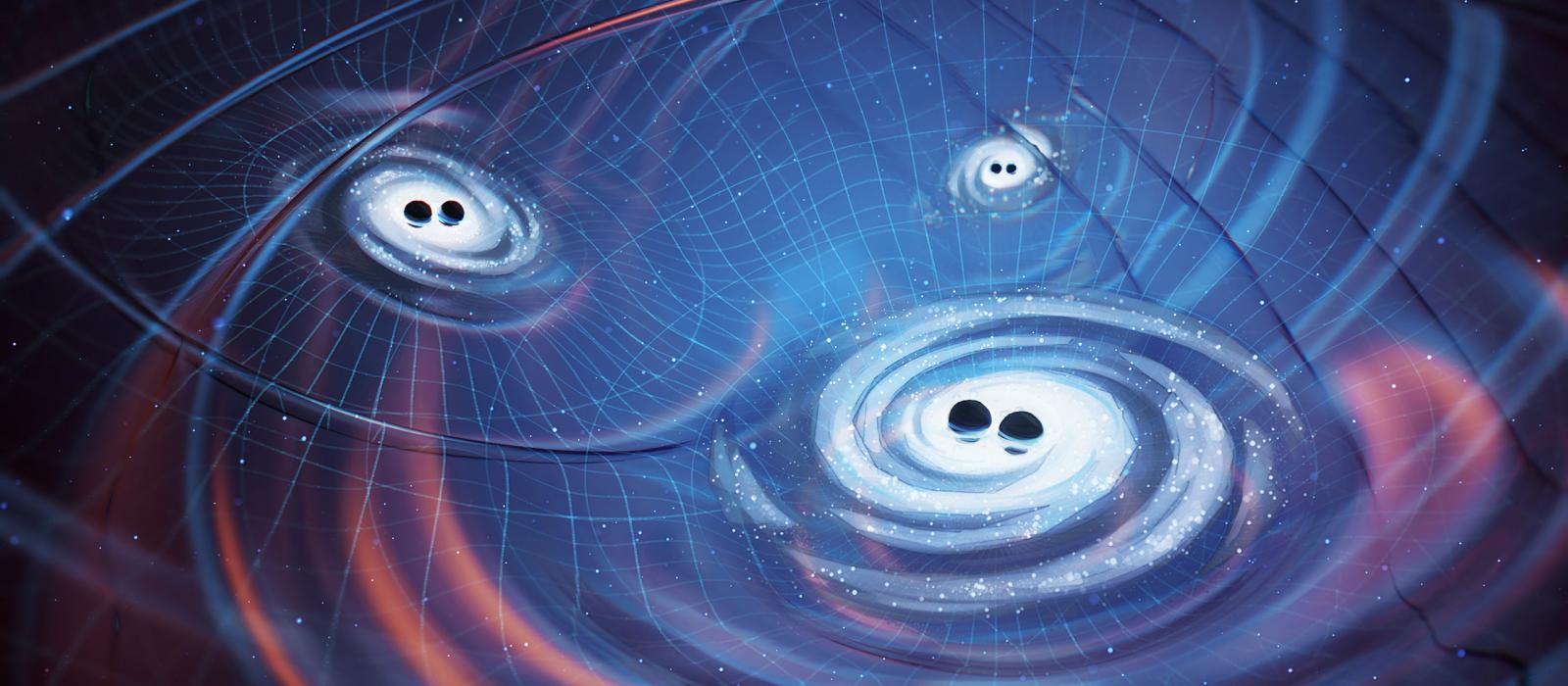
The discovery of gravitational waves (GWs) in 2015 marked a significant milestone in astrophysics, confirming a key prediction of Einstein’s Theory of General Relativity. Now, researchers from the University of Amsterdam (UvA) have proposed a groundbreaking method to utilize these waves for probing one of the universe’s greatest mysteries: the nature of dark matter. This innovative study, published in the journal Physical Review Letters, highlights how GWs generated by merging black holes could reveal insights into the elusive substance that constitutes approximately 65% of the universe’s mass.
The research team, led by Rodrigo Vicente, Theophanes K. Karydas, and Gianfranco Bertone from the UvA’s Institute of Physics (IoP) and the Gravitation & Astroparticle Physics Amsterdam (GRAPPA), focused on how binary black holes or other compact objects, such as neutron stars, interact as they spiral inward to form more massive black holes—phenomena known as Extreme Mass-Ratio Inspirals (EMRIs).
New Framework for Understanding Gravitational Waves
This research is part of a long-term effort to enhance predictions regarding gravitational waves and extract valuable information from them. Previous studies have typically employed simplified models to describe the interaction between black holes and their environments. In contrast, this new paper introduces a comprehensive relativistic framework, utilizing General Relativity to analyze how a black hole’s environment influences EMRIs’ orbits and the resulting GWs.
By focusing on dense concentrations of dark matter that may surround massive black holes, the researchers demonstrated that these “spikes” or “mounds” of dark matter could leave distinct imprints on gravitational wave signals. This innovative approach provides a fresh perspective on the interplay between dark matter and black hole mergers, potentially allowing scientists to discern the presence of dark matter through gravitational waves.
Future Implications for Space-Based Observatories
Looking ahead, the European Space Agency (ESA) plans to launch the Laser Interferometer Space Antenna (LISA) within the next decade. This pioneering space-based observatory is designed specifically for the study of gravitational waves and is expected to detect over 10,000 GW signals during its mission. The findings from the UvA research not only illuminate what astronomers might discover with LISA but also complement data from existing detectors such as the Laser Interferometer Gravitational Wave Observatory (LIGO) and the Virgo Collaboration.
This work represents a significant advancement in the emerging field of research aimed at using gravitational waves to map the distribution of dark matter throughout the universe. By combining advanced models with a relativistic framework, the study offers a promising avenue for shedding light on the composition and nature of dark matter, which has long baffled scientists.
In conclusion, as the field of astrophysics continues to evolve, the collaboration between gravitational wave research and dark matter investigation opens new doors to understanding the fundamental workings of our universe. The implications of this study could extend far beyond theoretical physics, potentially transforming our grasp of cosmic structure and evolution.