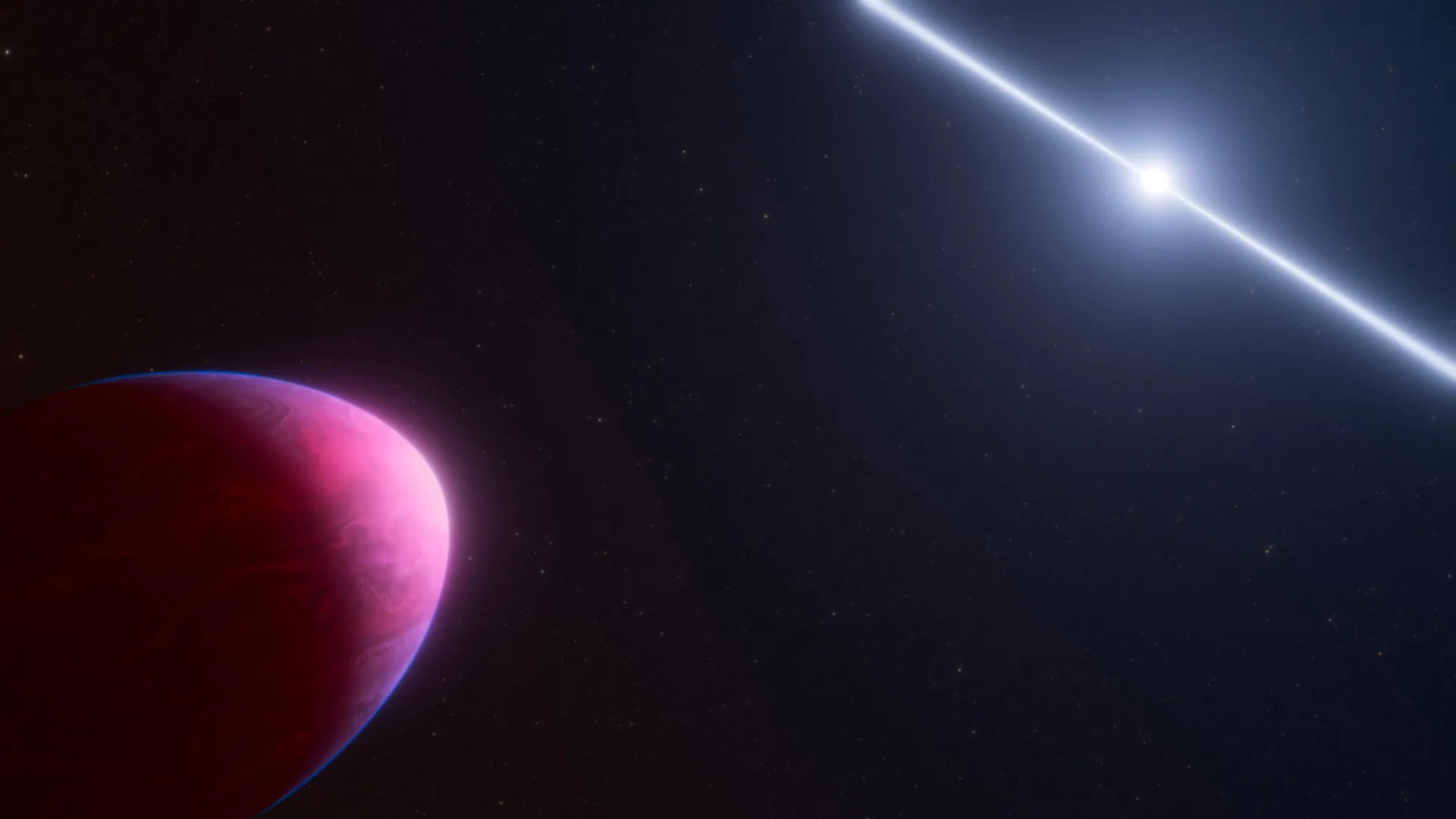
Scientists using NASA’s James Webb Space Telescope have made a groundbreaking discovery of a new type of exoplanet, named PSR J2322-2650b. This planet, which orbits a neutron star, features a carbon-rich atmosphere that challenges existing theories of planetary formation. The findings were announced on January 1, 2026, by researchers from the University of Chicago and other institutions.
PSR J2322-2650b exhibits peculiar characteristics, including a mass comparable to Jupiter and a unique lemon-like shape due to the extreme gravitational forces exerted by its host star. Its atmosphere is dominated by helium and carbon, unlike the more familiar compositions of other known exoplanets. The planet also completes an orbit in just 7.8 hours, a stark contrast to Earth’s year-long cycle around the Sun.
A Planet Unlike Any Other
Astrophysicist Michael Zhang, the principal investigator of the study, remarked on the planet’s unusual formation: “This is a new type of planet atmosphere that nobody has ever seen before.” The researchers were astonished to find dark soot-like clouds instead of the expected molecules such as water or methane. The carbon present in the atmosphere may be subjected to such high pressures that it could crystallize into diamonds beneath the surface.
The planet orbits a rapidly spinning neutron star, or pulsar, which emits powerful beams of radiation. This environment allows researchers to observe the planet throughout its orbit, a rare opportunity since most stars are significantly brighter than their planets. According to Maya Beleznay, a graduate student at Stanford University, “This system is unique because we are able to view the planet illuminated by its host star, but not see the host star at all.”
Unraveling the Mystery of Formation
The existence of PSR J2322-2650b raises questions about how such a carbon-enriched planet can form. Zhang noted that “it seems to rule out every known formation mechanism.” The intense gravitational pull from the neutron star stretches the planet, leading to its unusual shape and atmospheric composition.
The research team, including Peter Gao from the Carnegie Earth and Planets Laboratory, expressed their surprise upon receiving the initial data. “What the heck is this?” was the collective reaction after analyzing the findings. The planet is categorized within a rare type of system known as a black widow, where a pulsar gradually strips material from its companion, which in this case is classified as an exoplanet.
Potential explanations for the planet’s unique atmosphere have been proposed by experts like Roger Romani from Stanford University. He suggested that as the planet cools, carbon and oxygen may crystallize, resulting in the formation of pure carbon crystals that mix with helium in the atmosphere. The ongoing research aims to uncover the mechanisms that could allow for such an unusual composition.
The discovery was made possible by the James Webb Space Telescope, which utilizes its advanced infrared capabilities to detect faint signals from distant celestial bodies. Positioned about one million miles from Earth, the telescope’s sensitive instruments can operate without interference from terrestrial heat, making such observations feasible.
The collaborative efforts of researchers from various institutions, including the University of Chicago and the Kavli Institute for Particle Astrophysics and Cosmology, have been crucial in advancing our understanding of this extraordinary exoplanet. Funding for the research was provided by NASA and the Heising-Simons Foundation.
As scientists continue to investigate PSR J2322-2650b, the excitement surrounding its unique characteristics and the implications for planetary science grow. With each new finding, researchers are eager to learn more about the mysteries of this carbon-rich world and what it reveals about the universe.