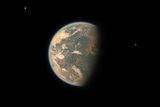
Recent astronomical research highlights the search for Earth-like exoplanets, revealing that while several candidates exist, none are exact replicas of our planet. Notably, the exoplanet Kepler 452b stands out, located in the habitable zone of a G-type star similar to our sun. Despite the excitement surrounding discoveries, experts caution that true Earth analogs remain elusive.
Over the past three decades, astronomers have identified more than 6,000 planets beyond our solar system, according to NASA. The central question remains: Could any of these planets support extraterrestrial life? As the only confirmed planet to do so, Earth serves as the benchmark for comparison, leading scientists to focus on rocky planets that share similar characteristics.
While many rocky exoplanets have been discovered, they predominantly orbit M dwarf stars, commonly referred to as red dwarfs. These stars possess a narrower habitable zone and emit more harmful radiation than G-type stars, making them less favorable for life. Stephen Kane, a planetary astrophysicist at the University of California, Riverside, emphasizes that despite the findings, “we really haven’t found anything like that at all” when referring to Earth-sized planets orbiting sun-like stars.
Challenges in Identifying Earth-Like Exoplanets
The difficulty in locating Earth-sized planets stems from their small size and dimness, which makes direct imaging nearly impossible. Most of what is known about these exoplanets comes from indirect observations, primarily concerning measurements of size, mass, and orbit. Kane notes, “We don’t know what they look like, even on a single pixel,” underscoring the limitations of current technology.
The TRAPPIST-1 system, situated about 39 light-years away in the constellation Aquarius, is often cited as a strong candidate for extraterrestrial life. This system contains seven planets within the habitable zone, all of which appear rocky. However, the volatile nature of the red dwarf star raises concerns regarding the potential for atmospheres on these planets. Observations from the James Webb Space Telescope suggest that some may lack atmospheres entirely, as detailed in a recent study published in The Astrophysical Journal.
Similarly, a system of three exoplanets orbiting Teegarden’s Star, located 12 light-years away in the constellation Aries, presents a tantalizing possibility. These planets have ideal sizes and distances from their star, yet the fact that they orbit a red dwarf diminishes their chances of supporting life, according to the Infrared Processing and Analysis Center (IPAC) at Caltech. Given that red dwarfs are the most prevalent type of star in the universe, many exoplanets may exist in conditions hostile to life.
Innovative Methods for Exoplanet Discovery
Astronomers primarily rely on the transit method to discover exoplanets. This technique involves observing a planet as it passes between its star and Earth, temporarily blocking a measurable amount of light. This alignment is crucial, as improperly oriented orbits can prevent detection. The Kepler Space Telescope, which operated from 2009 to 2018, surveyed 170,000 stars but identified only about 2,700 confirmed exoplanets, highlighting the challenges faced by astronomers.
Kane argues for a shift in the search for exoplanets, emphasizing alternative methods such as measuring a star’s “radial velocity.” This technique detects the slight wobble of a star caused by the gravitational pull of orbiting planets, allowing scientists to infer their presence, mass, and orbital distance.
The aspiration to directly image Earth-like exoplanets remains a significant goal for astronomers. Current technology has yet to achieve this feat, partly due to the size of these planets and the overwhelming brightness of their stars. However, advancements are on the horizon. The Nancy Grace Roman Space Telescope, set to launch in 2027, will feature a coronagraph designed to block starlight, potentially providing the first clear images of distant exoplanets.
Looking further ahead, the Habitable Worlds Observatory (HabWorlds), tentatively scheduled for launch in the late 2030s or early 2040s, aims to specifically survey the cosmos for alien biosignatures. With the largest mirror ever sent into space, it could detect atmospheric molecules indicative of life.
As the search for habitable exoplanets continues, Kane remains optimistic about future discoveries. “The last 20 years have been incredible. Let’s see where we are in another 20 years,” he states, highlighting the ongoing journey into the cosmos. With advancements in technology and ongoing research, the possibility of finding another Earth-like planet is an exciting prospect for the scientific community.