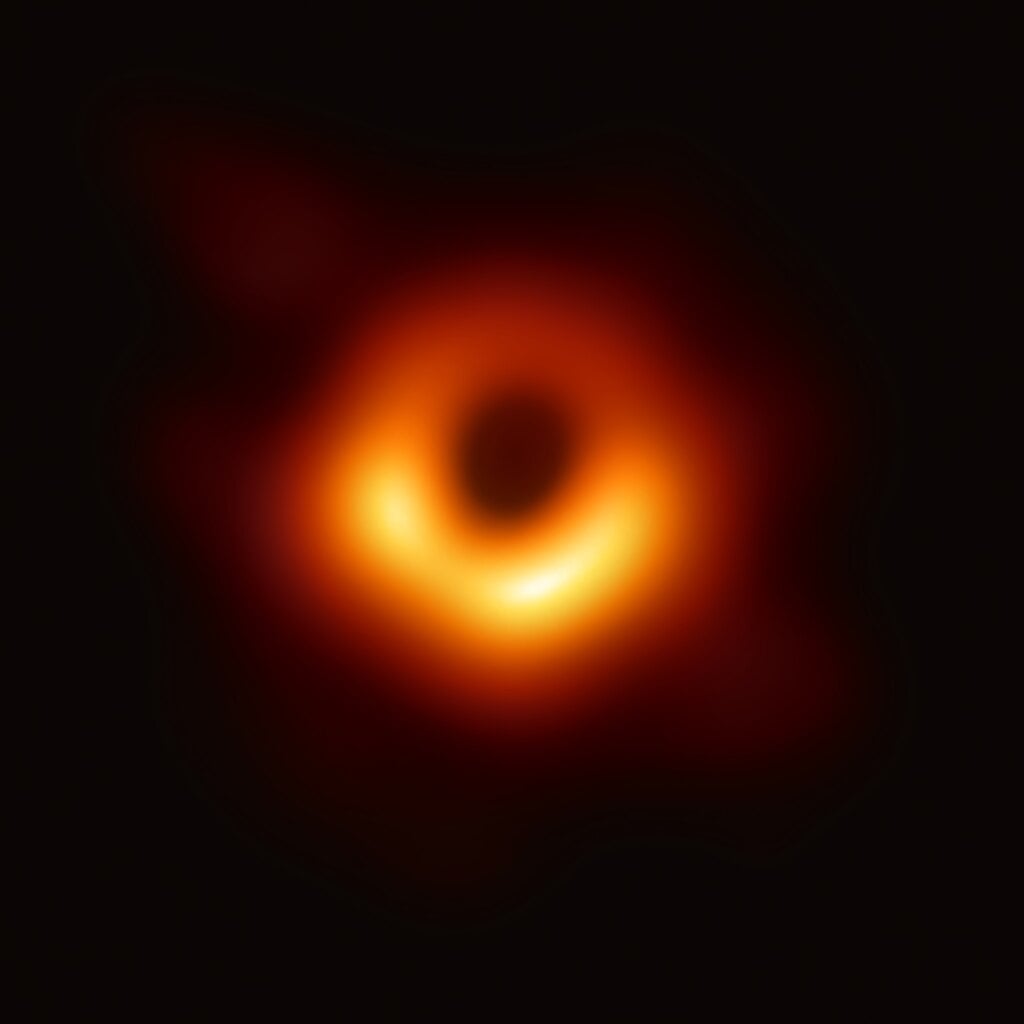
Scientists are embarking on a groundbreaking project to create three-dimensional films of black holes, aiming to revolutionize our understanding of these enigmatic cosmic phenomena. This initiative follows the landmark achievements of capturing the first images of black holes—specifically, the supermassive black holes at the centers of the galaxies M87* and Sagittarius A*—in 2019 and 2022, respectively. The project, backed by a funding of £4 million, seeks to provide dynamic visualizations that go beyond static images, revealing the intricate behaviors of plasma and magnetic fields surrounding these gravitational giants.
Transforming Black Hole Research with 3D Movies
Dr. Kazunori Akiyama, a key figure in the imaging teams responsible for the initial black hole photographs, is collaborating with Professor Yves Wiaux at Heriot-Watt University. Together, they are developing a technique called “dynamic gravitational tomography.” This innovative approach aims to depict how plasma flows and evolves over time in the vicinity of black holes, offering a comprehensive look at the dynamics involved.
The Event Horizon Telescope (EHT), which facilitated the first black hole images, employs a network of radio telescopes distributed globally. This arrangement acts as a virtual Earth-sized telescope, achieving remarkable resolution. However, the challenge lies in transforming the incomplete data from this vast network into coherent images, a task requiring advanced computational algorithms. Dr. Akiyama previously developed one such algorithm for the original photographs. In parallel, Professor Wiaux has been at the forefront of artificial intelligence techniques that reconstruct images from incomplete data, fostering advancements across various scientific disciplines.
Unlocking the Mysteries of Black Holes
The new TomoGrav project promises to uncover critical dynamics surrounding black holes that have long remained obscured. The spinning nature of black holes plays a crucial role in determining the energy extracted from infalling matter. This process fuels colossal jets that can extend across thousands of light years, profoundly influencing galaxy formation and evolution. While these jets have been observed, the mechanisms behind their formation have not yet been visualized.
By creating time-resolved 3D maps of magnetic fields and plasma around black holes, researchers will showcase the interactions occurring as matter spirals inward. This will elucidate how these processes generate magnetic fields that channel energy outward, providing unprecedented insights into the workings of black holes.
Additionally, the research aims to deliver rigorous tests of Einstein’s general relativity under extreme conditions. The team plans to collaborate with the proposed Black Hole Explorer space mission, which seeks to accurately map photon rings—light that has orbited a black hole multiple times before escaping. These measurements will offer a unique opportunity to study gravity in regions where spacetime is curved most severely.
The TomoGrav project represents a significant leap forward in our quest to understand black holes. As scientists continue to push the boundaries of astronomical research, the ambition to visualize these cosmic titans in three dimensions marks a new chapter in the exploration of the universe’s most mysterious entities.