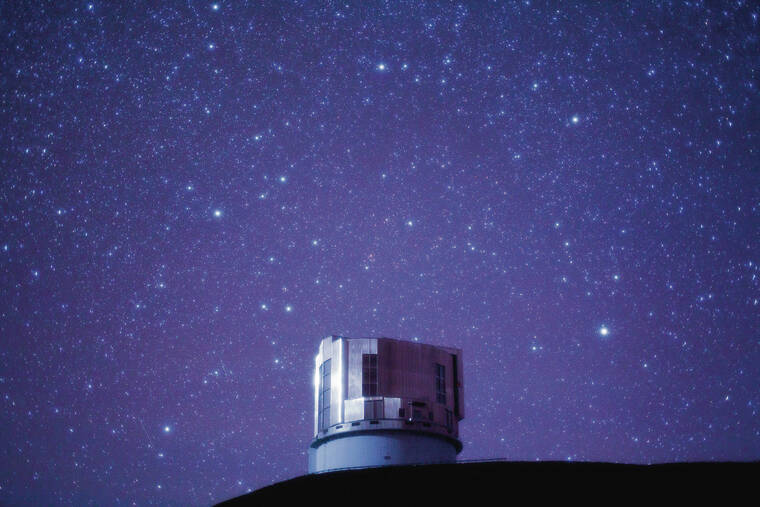
A team of astronomers utilizing the Subaru Telescope and W.M. Keck Observatory on Mauna Kea has made significant discoveries in the field of astrophysics, identifying a massive planet and a brown dwarf orbiting distant stars. These findings, part of the Observing Accelerators with SCExAO Imaging Survey program (OASIS), provide new insights into the formation and evolution of giant planets and substellar objects.
Groundbreaking Discoveries Enhance Understanding of Celestial Bodies
The first notable discovery, designated HIP 71618 B, is a brown dwarf with a mass equivalent to approximately 60 times that of Jupiter. Located about 169 light-years away in the constellation Bootes, this brown dwarf is often referred to as a “failed star.” Despite forming like a star, it lacks the mass necessary to initiate nuclear fusion, resulting in its cooler and fainter characteristics compared to traditional stars.
Data collected from both the Keck/NIRC2 and Subaru/SCExAO systems over a short time frame enabled researchers to determine the companion’s orbit. The implications of this discovery could further enhance our ability to image Earth-like planets with upcoming space-based observatories, such as NASA’s Roman Space Telescope, according to Thayne Currie, a professor at the University of Texas at San Antonio and principal investigator of the OASIS program.
The second companion, identified as HIP 54515 b, is an 18-Jupiter-mass planet orbiting a star situated 271 light-years away in the constellation Leo. This planet orbits its star at a distance comparable to that of Neptune from the Sun, making it appear extraordinarily close from Earth. The Subaru Telescope’s SCExAO system provided the high-resolution images necessary to distinguish this faint giant planet against the backdrop of its considerably brighter host star.
Upcoming Astronomical Events and Cultural Significance
In addition to these discoveries, the Quadrantids meteor shower is expected to peak on the night of January 3 into early morning January 4, 2024. Known for producing bright meteors, this event will see optimal viewing conditions in Hawaii, thanks to minimal moonlight interference. Observers can anticipate seeing up to 40 meteors per hour during the shower’s peak.
As January progresses, the star family Kekaomakali‘i, or the “Bailer of Makali‘i,” will continue to dominate the night sky. This collection of stars plays a crucial role in traditional Hawaiian navigation, including notable stars such as Hokulei (Capella) and Kapuahi (Aldebaran). The Makali‘i (Pleiades) cluster will also be prominent, representing a time of rest and reflection in Hawaiian culture.
For those interested in early morning observations, Jupiter will remain visible in the pre-dawn western sky throughout January, serving as a brilliant guide for stargazers. The stars and planets provide not only a source of fascination but also a connection to the rich navigational traditions of the Pacific.
The discoveries from the OASIS program signify a remarkable step forward in our understanding of celestial formations, blending cutting-edge technology with the unparalleled observing conditions offered by Mauna Kea. For further details about the program, visit the Keck Observatory and Subaru Telescope websites.