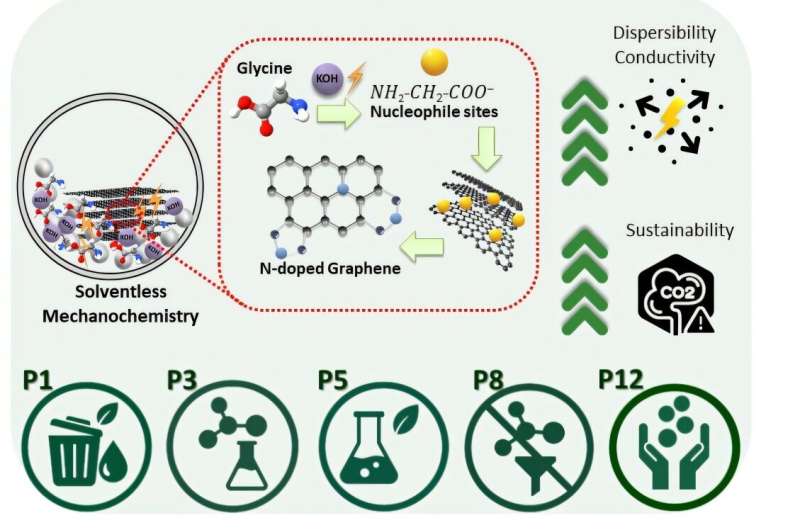
Graphene, often hailed as a revolutionary material, is known for its impressive strength, electrical conductivity, and thermal efficiency. Despite its potential, many graphene-based technologies remain confined to laboratory settings due to challenges in functionalization. A recent study led by Chamalki Madhusha from Monash University has introduced a more sustainable method for producing functionalized graphene materials, paving the way for advancements in various applications.
Addressing the Challenges of Graphene Functionalization
Pristine graphene possesses remarkable qualities, yet its use in advanced applications—such as smart coatings and conductive composites—often requires chemical modifications. One common method is nitrogen doping, which enhances graphene’s electronic structure and improves its compatibility with solvents and polymer matrices. Traditional nitrogen doping techniques, however, present significant drawbacks, including reliance on toxic nitrogen precursors, energy-intensive purification processes, and high-temperature post-annealing steps exceeding 600 °C. These methods generate substantial chemical waste, raising concerns about their environmental impact.
Madhusha’s research, published on December 25, 2025, in ACS Sustainable Chemistry & Engineering, explores a novel approach to producing nitrogen-doped graphene nanoplatelets (N-GNPs) using a solvent-free, bio-derived mechanochemical process. This innovative technique offers a more sustainable pathway for functionalized graphene materials by eliminating the need for harsh chemicals and reducing waste generation.
Mechanochemistry: A Sustainable Alternative
Mechanochemistry employs mechanical forces—such as shear, impact, and friction—to drive chemical reactions, making it a promising method in green chemistry. By utilizing a ball-milling process, Madhusha and her colleagues functionalized graphite with a bio-derived nitrogen source, specifically amino acids, at ambient conditions. This method circumvents the need for solvents and toxic reagents, allowing for the direct functionalization of materials in solid state.
The resulting N-GNPs exhibit high electrical conductivity and good dispersibility, effectively addressing two significant challenges in graphene processing. Furthermore, the process achieved a material yield of approximately 80%, which is notable for solid-state synthesis.
To assess the sustainability of their approach, the researchers measured both qualitative and quantitative metrics, including waste generation and overall energy consumption. The mechanochemical method demonstrated a significantly lower E-factor compared to traditional graphene functionalization strategies, affirming its environmental advantages. By eliminating solvents and reducing energy use, this method exemplifies how design choices can enhance the sustainability of advanced materials.
The incorporation of nitrogen into the graphene lattice enhances its electrical conductivity and chemical reactivity, making N-GNPs valuable as nanofillers in composite systems. These materials can improve the electrical, thermal, and mechanical properties of composites, all while maintaining high structural integrity.
Implications for Future Materials Design
One of the most exciting outcomes of this research is the compatibility of N-GNPs with vitrimers, a class of polymers that combine the mechanical strength of thermosets with the reprocessability of thermoplastics. When incorporated into vitrimer matrices, N-GNPs can serve as multifunctional fillers, enabling electrically triggered self-healing capabilities and enhancing overall material performance.
This advancement holds significant potential for the development of repairable coatings and recyclable composites, addressing the growing demand for sustainable materials in industries such as electronics, aerospace, and energy storage. As environmental considerations become increasingly critical, the integration of green chemistry principles in materials design will play a pivotal role in shaping future technologies.
Madhusha’s work represents a key step toward aligning nanomaterials innovation with sustainability goals. Future research aims to adapt this green synthesis method for other dopants and composite systems, further enhancing the scalability and applicability of these techniques. Ultimately, the goal is to create not just better materials, but better methods of production that prioritize both performance and sustainability.
In conclusion, this research underscores the importance of rethinking advanced materials production processes. By employing mechanochemical, solvent-free strategies, it is possible to reduce waste and energy use, paving the way for the development of high-performance materials that also prioritize environmental responsibility. As the demand for innovative functional materials continues to rise, sustainable synthesis strategies will be instrumental in shaping the industries of tomorrow.