Astronomers are turning their attention to old stars in a quest to uncover the nature of dark matter by investigating a theoretical particle known as the axion. In a study published in November 2025 on the open-access server arXiv, researchers explored the potential impact of axions on white dwarfs, the dense remnants of dead stars. Their findings provide valuable insights, even though they did not detect any direct evidence of axions.
The axion was conceived decades ago to address a perplexing issue with the strong nuclear force. Initial efforts to locate this particle using particle colliders were unsuccessful, causing interest in it to wane. Recent studies, however, have revived the axion’s status as a promising candidate for explaining dark matter, which remains one of the universe’s greatest mysteries. Researchers suggest that axions might exist in vast quantities yet remain elusive to direct detection.
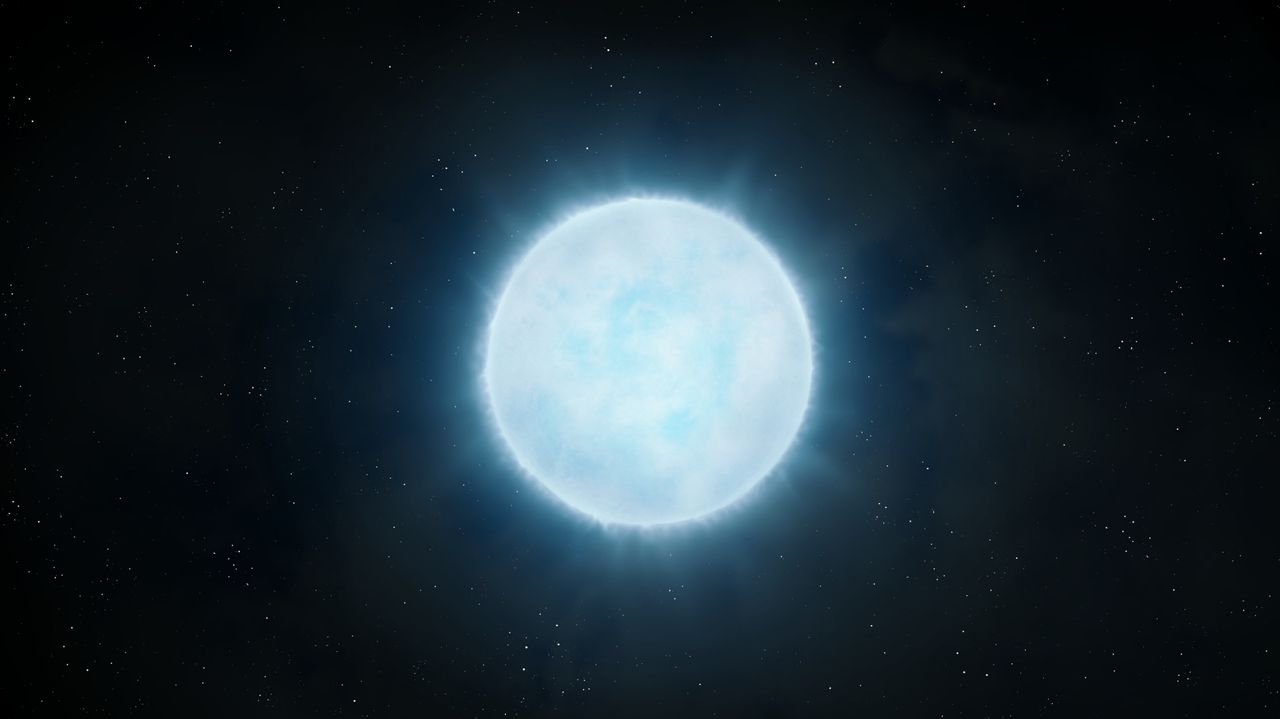
White dwarfs were the focal point of this recent study. These celestial bodies condense the mass of the sun into a volume smaller than that of Earth, making them some of the most intriguing objects in the cosmos. They maintain structural integrity through a principle called electron degeneracy pressure, where a sea of free electrons prevents collapse by adhering to quantum mechanics, which states that no two electrons can occupy the same state.
The theory proposes that axions could be generated by electrons within a white dwarf. If electrons move at high speeds—nearly the speed of light—they may produce axions. These axions would escape from the white dwarf, leading to a loss of energy and resulting in a faster cooling rate. Given that white dwarfs do not generate energy, this cooling effect could significantly alter their lifespan.
To test this hypothesis, researchers employed a sophisticated software suite designed to simulate stellar evolution. This model enabled them to predict the temperatures of white dwarfs according to their age, both with and without the influence of axion-induced cooling.
Armed with their theoretical framework, the team analyzed data from the globular cluster 47 Tucanae, gathered by the Hubble Space Telescope. Globular clusters are particularly valuable for such studies as they contain populations of white dwarfs that were formed simultaneously, providing a broad sample for analysis.
The results revealed no evidence of axion cooling within the white dwarf population of 47 Tucanae. However, the researchers were able to establish new constraints regarding the production of axions by electrons. They found that electrons cannot create axions more efficiently than once in a trillion attempts. While this finding does not eliminate the possibility of axions existing, it does indicate a low likelihood of direct interactions between electrons and axions.
The implications of this research are significant for the ongoing search for axions and dark matter. Researchers acknowledge that they will need to devise more innovative methods to investigate these elusive particles further. The quest to understand dark matter continues, and the role of axions in this cosmic puzzle remains an open question.