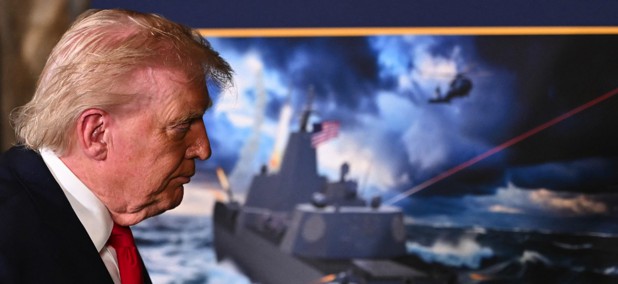
President Donald Trump has unveiled plans for a new class of warships that raises significant concerns regarding nuclear armament. The proposed vessels, often referred to as “battleships,” are set to be equipped with a new nuclear-armed cruise missile, a decision that appears to contradict Trump’s earlier stance on nuclear weapons. In February, he stated, “There’s no reason for us to be building brand-new nuclear weapons. We already have so many.”
This contradiction is notable, especially in light of historical context surrounding nuclear-armed, sea-launched cruise missiles, known as SLCM-N. In 1991, former President George H.W. Bush ordered the removal of all nuclear-armed Tomahawk cruise missiles from U.S. Navy surface ships and submarines, deeming their forward deployment dangerously destabilizing. This decision prioritized the storage of these tactical nuclear weapons, a policy later reinforced by former President Barack Obama, who dismantled them permanently in 2011.
In a surprising turn of events, the 2018 Nuclear Posture Review, endorsed by Trump’s Secretary of Defense James Mattis and Joint Chiefs Chairman Gen. Mark Milley, called for the development of a new SLCM-N. Although President Joe Biden canceled this initiative in 2021, Congress intervened, continuing to allocate funds for the project. This intervention marked a rare instance where Congress compelled the executive branch to initiate a new nuclear weapon program.
As a former Assistant Secretary of Defense for Nuclear, Chemical, and Biological Defense Programs, I support the modernization of our strategic nuclear triad. However, the proposed SLCM-N raises critical concerns for three main reasons. First, it risks conveying to adversaries, such as Vladimir Putin, that a limited nuclear strike could be met with a proportionate response. This could undermine deterrence, as a robust retaliatory strategy should evoke fear of overwhelming consequences for any use of nuclear weapons.
Second, the introduction of tactical nuclear weapons like the SLCM-N could lead to their use in regional conflicts. Once the nuclear threshold is crossed, the likelihood of escalation to a full-scale nuclear exchange increases dramatically. This scenario is particularly alarming given the unpredictable nature of modern warfare.
Finally, these weapons could heighten the risk of miscalculation or accidental nuclear conflict. Many conventional weapons closely resemble their nuclear counterparts, leading to confusion in a contested environment where intelligence capabilities are compromised. An adversary may mistakenly interpret an incoming threat as nuclear, prompting a potentially catastrophic response.
Given these considerations, it is imperative that we do not dilute the effectiveness of our strategic nuclear arsenal by pursuing a “tactical” approach. Trump’s ambition to advance a new battleship program presents an opportunity to reinforce his previous commitments. Rather than investing in new nuclear weapons, focusing on enhancing conventional military capabilities would better serve national security interests.
In conclusion, the development of the SLCM-N represents a significant deviation from established nuclear policy and poses various risks that could destabilize global security. As discussions surrounding the future of U.S. military capabilities evolve, it is crucial to prioritize strategies that ensure safety and deterrence without compromising the hard-earned lessons of history.