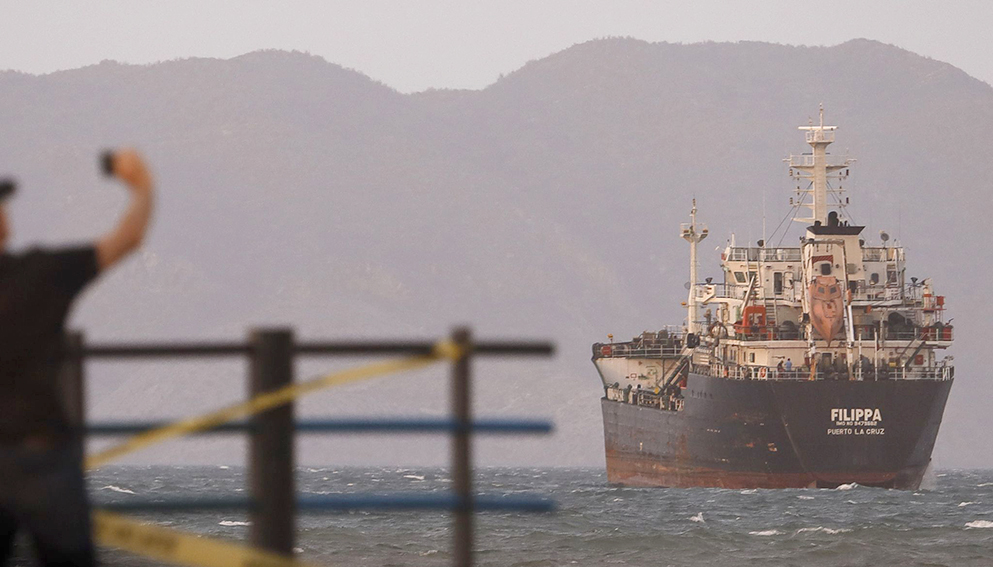
China has condemned the United States for its recent seizure of oil tankers off the coast of Venezuela, marking a significant escalation in tensions between Washington and Beijing. The Chinese government expressed strong support for Caracas, emphasizing its opposition to what it describes as unilateral actions by the U.S. that undermine international law.
During a regular press briefing in Beijing on October 30, 2023, Lin Jian, the spokesman for the Chinese Foreign Ministry, criticized the U.S. for its actions, stating, “The U.S. practice of arbitrarily seizing other countries’ vessels grossly violates international law.” This statement reflects China’s commitment to supporting Venezuela amid ongoing U.S. efforts to tighten its blockade on the country’s oil exports, a strategy that aims to cripple the Venezuelan economy and isolate the government of Nicolás Maduro.
Beijing’s backing of Caracas comes as the U.S. intensifies its efforts to target a third oil tanker, a move that reflects the Trump administration’s objectives of cutting off vital economic lifelines to Venezuela. According to reports, state-owned Petróleos de Venezuela SA typically exports most of its oil cargo to China, often through intermediary vessels known as “dark-fleet” tankers. These older ships have obscure ownership and are used to transport sanctioned oil from Venezuela, as well as from countries like Iran and Russia.
Lin further asserted that “Venezuela has the right to independently develop mutually beneficial cooperation with other countries,” reinforcing China’s position that it stands with Venezuela in defending its sovereignty and legitimate rights. This statement underscores China’s broader strategy to challenge U.S. dominance in international affairs and support allies facing economic sanctions.
The ongoing confrontation between the U.S. and Venezuela has broader implications for global oil markets. The blockade aims to limit Venezuela’s oil production, which has already plummeted due to years of economic mismanagement and international sanctions. As tensions rise, the situation may affect oil prices and international trade dynamics, particularly in regions reliant on Venezuelan oil.
China’s firm response is part of a larger pattern of increasing diplomatic friction with the U.S. over various geopolitical issues, including trade policies, human rights, and territorial disputes in the South China Sea. As both nations navigate this complex relationship, the potential for further economic and political ramifications remains significant.
In conclusion, the U.S. seizure of oil tankers off the coast of Venezuela has not only strained relations between Washington and Caracas but has also drawn a strong rebuke from China. With both nations standing firm in their positions, the international community will be closely watching the developments in this situation and their potential impact on global geopolitics.