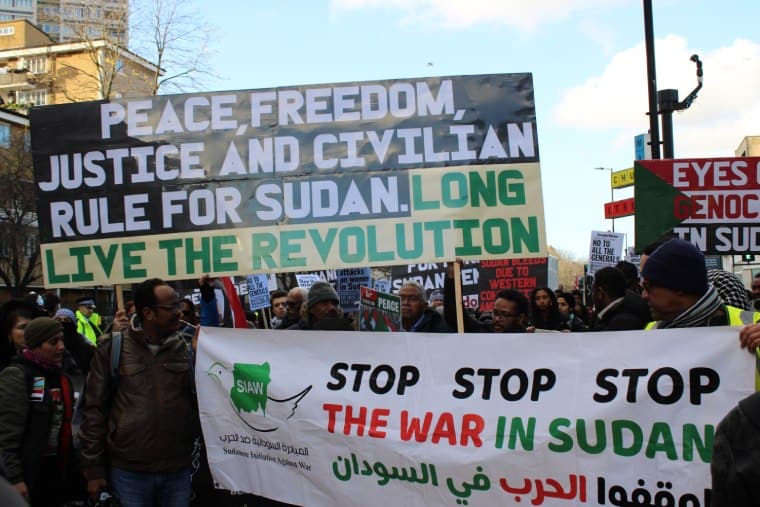
On Saturday, up to 400 Sudanese activists and their supporters marched through central London, commemorating the anniversary of the revolution that began on December 19, 2018. The demonstrators urged the international community not to forget Sudan, where civilians are enduring severe violence amid a civil war that has claimed approximately 400,000 lives and left millions displaced, desperately in need of humanitarian assistance.
The conflict escalated in April 2023 when factions of a counter-revolution turned against each other. According to a recent briefing for British Members of Parliament, around 150,000 residents of El Fasher in the Darfur region remain unaccounted for after the RSF militia’s attack on the city in October. Reports indicate that at least 60,000 people have been killed, transforming a once-thriving city of 1.5 million into what some describe as a mass graveyard.
Calls for Action Against Violence and Complicity
Protesters voiced strong criticisms against the British government, demanding an end to arms sales to the United Arab Emirates. They highlighted that these weapons have reportedly reached the RSF in exchange for Sudan’s gold. Additionally, the activists cautioned against placing trust in the Sudanese Armed Forces (SAF), which previously collaborated with the RSF to suppress the revolution.
Tasneem, a speaker at the rally, praised the courage of the Sudanese people for rising up seven years ago to challenge oppression and militarism. “The Sudanese revolution stands as a symbol of resistance,” she stated, emphasizing grassroots efforts toward democratic governance. “For many in Sudan, the Sudanese Armed Forces seem to represent the last line of defense against the RSF’s brutality. Yet we must also face the truth that the Sudanese Armed Forces has committed grave violations too.”
The sentiments shared by Tasneem reflect the complex dynamics within Sudan, where both the SAF and RSF have been implicated in human rights abuses.
Community Resilience Amidst Crisis
During the march, Elbashir from the Sudan Revolution Support Group in Cardiff discussed the community’s grassroots response to violence. He noted the formation of resistance committees to advocate for the revolution’s objectives and emergency response rooms to protect against counter-revolutionary threats. “The Sudanese have shown you how community works, how resilience works,” he remarked, highlighting how ordinary citizens have come together to support one another.
He further criticized the SAF, stating, “Just because the bully is crying now does not mean that they are right. These are the same ones who were killing our brothers and sisters and children seven years ago.”
Miriam, a member of the National Education Union (NEU), spoke about the vital role of organized labor in the revolution. She cited a strike by 35,000 teachers across Sudan in 2022 as an example of effective organization, stating, “The Sudanese teachers’ committee strike put us in this country to shame with the way they organized.”
The atmosphere during the demonstration echoed elements of the Palestinian solidarity movement, with marchers chanting, “From Gaza to Darfur, stop the killing, stop the war.” A notable presence was a large contingent supporting the demands of prisoners associated with Palestine Action currently on hunger strike in British prisons.
The London march served not only as a remembrance of Sudan’s revolutionary spirit but also as a call to action for international awareness and intervention against ongoing atrocities. As the Sudanese people continue to navigate their challenges, the global community is urged to remain vigilant and supportive.