Recent research suggests that cosmic rays from nearby supernovae could play a significant role in the formation of Earth-like planets. A team of scientists led by astrophysicist Ryo Sawada from the University of Tokyo has published findings that challenge long-standing beliefs about the origins of rocky planets in the universe.
For decades, planetary scientists theorized that the early solar system was enriched with short-lived radioactive elements such as aluminum-26 from a nearby supernova. These elements were thought to be crucial in the formation of water-depleted rocky planets like Earth. However, this classic theory raised questions due to the improbability of such a supernova occurring at just the right distance to deliver these elements without destroying the fragile protoplanetary disk.
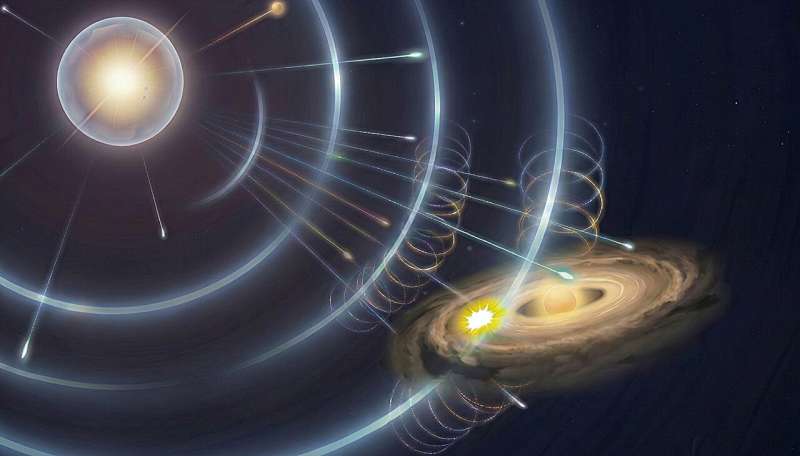
In exploring this issue, Sawada found that while supernovae are known for ejecting material, they also act as powerful particle accelerators. During these explosive events, shock waves generate a multitude of high-energy particles known as cosmic rays. Surprisingly, previous models of solar system formation largely overlooked these particles.
The study, published in Science Advances, proposes that instead of relying solely on supernova ejecta, the young solar system may have been immersed in a “cosmic-ray bath.” When cosmic rays interact with the protosolar disk, they can initiate nuclear reactions that produce radioactive elements like aluminum-26.
What emerged from their numerical simulations was notable. The research indicated that sufficient amounts of these elements could be generated at distances of approximately one parsec from a supernova, a distance commonly found in star clusters. At this range, the integrity of the protosolar disk remains intact, eliminating the need for an unlikely coincidence for Earth’s formation.
This mechanism presents a more universal process for the creation of Earth-like planets. Many sun-like stars are formed in clusters that include massive stars, which eventually explode as supernovae. If cosmic-ray baths are prevalent in these environments, the conditions that shaped Earth could be more common than previously thought.
The implications of this research are profound. If the formation of water-depleted rocky planets does not rely on rare supernova events, then such planets might be more prevalent in the universe. This challenges the notion that the conditions necessary for habitable planets are exceptionally rare.
While the study does not claim that supernovae guarantee the existence of habitable planets, it emphasizes that many factors—including disk lifetime, cluster structure, and stellar dynamics—still play crucial roles. The findings serve as a reminder of the interconnectedness of astrophysical processes, suggesting that insights from high-energy astrophysics can significantly influence our understanding of planetary science and habitability.
In conclusion, the research led by Ryo Sawada highlights the importance of cosmic rays in the formation of Earth-like planets. By reevaluating existing models and considering previously overlooked elements, scientists may be on the path to understanding more about our planet’s origins and the potential for life elsewhere in the universe.