UPDATE: The Kilauea volcano in Hawaii is experiencing a significant eruption that began on December 23, 2024, and is set for a new phase, with predictions for the next explosive episode between December 22 and 27, 2025. This eruption features unprecedented high lava fountaining and has drawn attention from scientists and visitors alike.
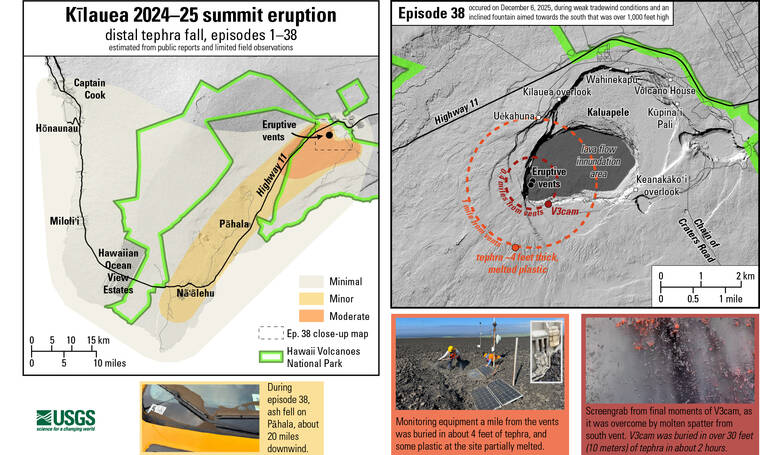
As of December 15, 2025, the eruption is currently paused, but the summit is showing signs of reinflation with intermittent glow visible at both vents. The recent activity, particularly Episode 38 on December 6, 2025, lasted for 12 hours and saw lava fountaining reach heights of over 460 meters (1,500 feet), reshaping the landscape around the Halema‘uma‘u crater.
Visitor safety is paramount, as hazards can escalate rapidly during these high-fountaining episodes. The USGS Hawaiian Volcano Observatory (HVO) warns that life-threatening conditions exist in areas of the Hawaii Volcanoes National Park that are currently closed to the public. Wind conditions can affect the spread of volcanic tephra, posing risks even to nearby communities.
The ongoing eruption style is rare, with only three documented instances of similar high fountaining in history: the 1959 Kilauea Iki eruption, the 1969-74 Maunaulu eruption, and the early episodes of Pu‘u‘o‘o from 1983 to 1986. Today, advanced monitoring technologies allow HVO to document the eruption in real-time, providing crucial forecasts of its behavior and potential hazards.
During Episode 38, the fountaining transitioned rapidly, demonstrating the unpredictable nature of volcanic activity. The south vent began producing powerful inclined fountaining that reached heights of over 300 meters (1,000 feet), which resulted in significant deposits of tephra over the area. This dramatic change serves as a reminder of how quickly volcanic hazards can evolve, sometimes within minutes.
Field engineers and geologists are working tirelessly to monitor the eruption, even as thick tephra deposits make access challenging. Their efforts are crucial for understanding the eruption’s dynamics, ensuring accurate forecasts, and maintaining safety protocols.
Local communities should remain vigilant, as volcanic air pollution (vog) can affect areas far beyond the immediate vicinity of Kilauea. There have been no significant earthquakes reported in the Hawaiian Islands recently, and the nearby Mauna Loa volcano remains quiet.
Scientists encourage everyone to stay informed by visiting the HVO website for real-time updates, eruption forecasts, and safety guidelines. As the volcano continues to evolve, the opportunity to witness this extraordinary natural phenomenon is both a privilege and a responsibility.
Public safety is paramount; follow all guidance from the Hawaii Volcanoes National Park, and remember that closed areas are restricted for everyone’s protection. The beauty and power of Kilauea’s eruptions provide a once-in-a-lifetime experience, but caution is essential as conditions can change without warning.
Stay tuned to HVO for updates and information on this captivating eruption as it develops.