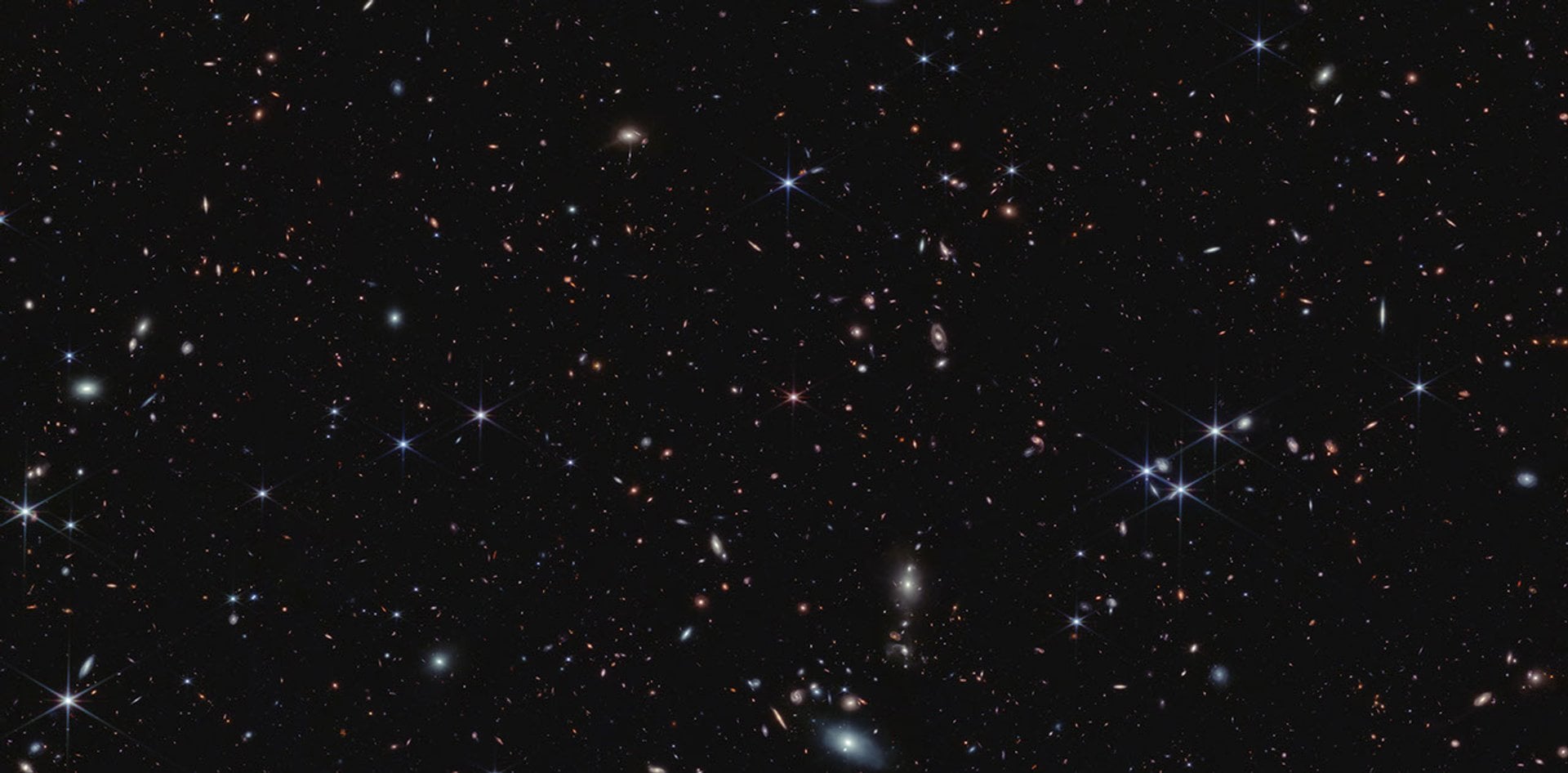
Astronomers using the James Webb Space Telescope (JWST) have found compelling evidence suggesting the existence of massive stars, referred to as “monster stars,” in the early universe. This discovery sheds light on the formation of supermassive black holes (SMBHs) less than one billion years after the Big Bang, a phenomenon that has puzzled scientists for over two decades.
The research, led by Devesh Nandal, a Postdoctoral Fellow at the University of Virginia and the Institute for Theory and Computation at the Harvard & Smithsonian Center for Astrophysics, indicates that these monster stars, ranging from 1,000 to 10,000 solar masses, could be the key to understanding the origins of SMBHs. This challenges the prevailing cosmological models that suggest there was insufficient time for massive black holes to form through conventional processes shortly after the Big Bang.
Investigating Chemical Signatures in GS 3073
The study focused on a galaxy identified as GS 3073, which was initially discovered in 2022 by a team that included Muhammad A. Latif and Daniel Whalen from the University of Portsmouth. During their examination, the researchers noted a remarkable nitrogen-to-oxygen ratio of 0.46, significantly higher than would be expected from any known stellar processes. This ratio suggests a unique chemical signature indicative of the first stars, known as Population III stars, which likely formed from turbulent flows of cold gas shortly after the Big Bang.
The presence of an actively feeding black hole at the center of GS 3073 supports the hypothesis that these monster stars may have collapsed directly into massive black holes, serving as the “seeds” for the SMBHs observed today. Such black holes are responsible for the powerful emissions seen in active galactic nuclei (AGNs), which can temporarily outshine all the stars in their host galaxies.
Understanding the Formation of Monster Stars
To test their theory, the research team modeled the life cycle of these massive stars and the specific chemicals they would produce. They discovered that as monster stars fuse helium in their cores to create carbon, this carbon combines with hydrogen in the outer layers of the stars to produce nitrogen. This nitrogen is then released into the surrounding space, contributing to the observed nitrogen-to-oxygen ratio.
Nandal commented, “This process enriches the surrounding gas cloud over millions of years, explaining the high nitrogen levels detected in GS 3073.” The team’s model indicates that these monster stars do not end their lives as typical supernovae; instead, they collapse into massive black holes, thus facilitating the formation of SMBHs.
The findings not only address the origins of SMBHs but also provide insights into the “Cosmic Dark Ages,” a period between 380,000 and 1 billion years after the Big Bang. Until the advent of instruments like the JWST, studying this epoch was challenging due to the faintness of light from that era.
The researchers anticipate that future observations will reveal more galaxies exhibiting similar nitrogen excesses, further validating the existence of monster stars. Whalen expressed optimism about the implications of these findings, emphasizing their potential to reshape our understanding of cosmic history.
This research underscores the transformative capabilities of the JWST, which continues to unlock mysteries of the universe, including the formation of the earliest stars and black holes. As astronomers push the boundaries of our knowledge, the quest to understand the cosmos evolves, revealing the complex interplay of elements that shaped the universe as we know it today.