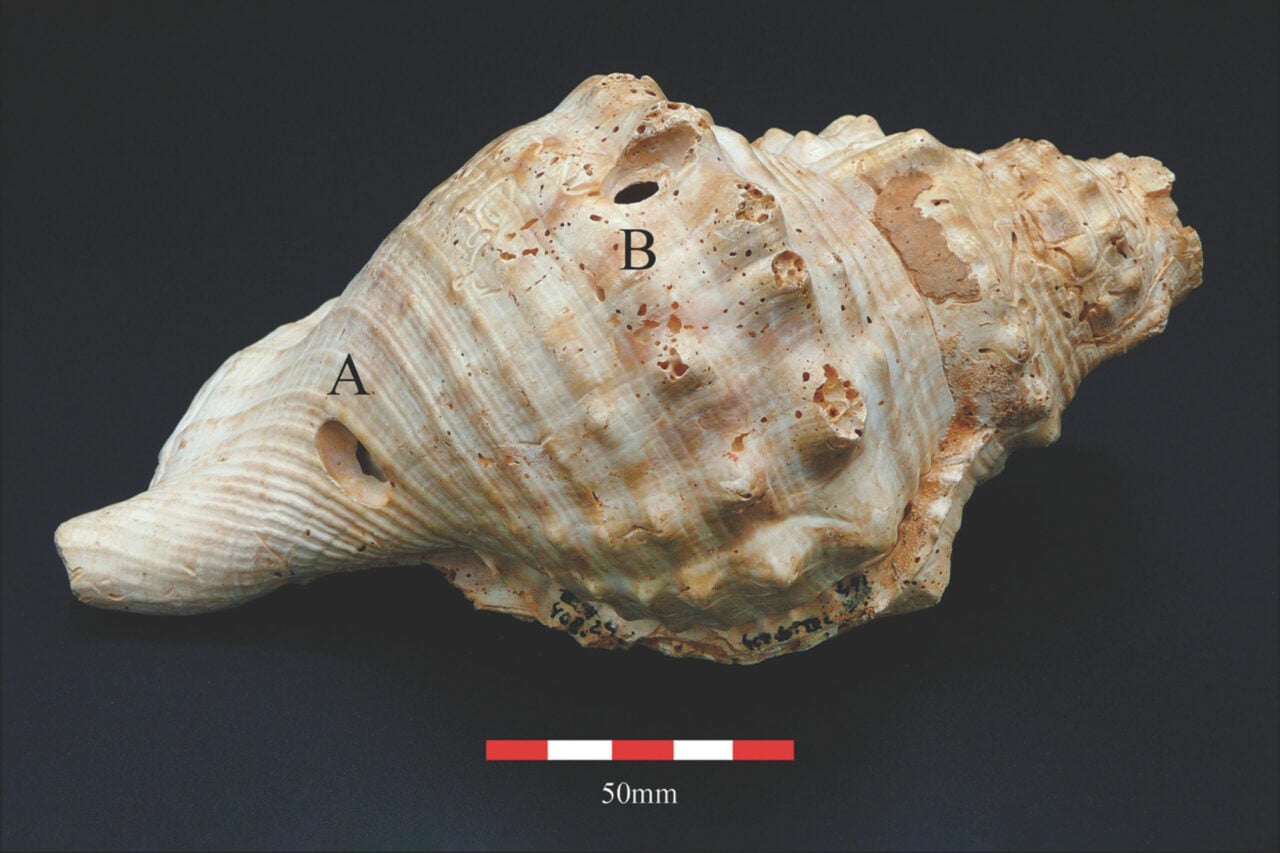
Prehistoric communities in modern-day Spain utilized large, spiral seashells not for mere decoration, but as significant communication tools and musical instruments. A study published in the journal Antiquity reveals that conch shell trumpets from Neolithic sites in Catalonia were likely used for long-distance communication and musical expression. Researchers conducted hands-on experiments with these archaeological artifacts to explore their acoustic capabilities.
The study focuses on the conch shells, specifically Charonia lampas, discovered in the lower course of the Llobregat River and the pre-coastal depression of the Penedès region. According to Margarita Díaz-Andreu, co-author of the study and archaeologist at the University of Barcelona, the apexes of these shells were removed, suggesting their potential use as musical instruments.
Evidence indicates that ancient communities gathered these shells after the mollusks had died, repurposing them as tools to create sound rather than for consumption. To investigate their functionality, Díaz-Andreu and co-author Miquel López-García, also an archaeologist at the same university, analyzed the shells and played them to understand their sound characteristics. The shells studied date back between 5,000 and 7,000 years, leaving researchers curious about the sounds they once produced.
López-García, who is also a professional trumpet player, assessed the shells not only for their potential as communication devices but also for their musical capabilities. He stated, “The shell trumpets are capable of producing high-intensity sounds and would have been highly effective for long-distance communication. However, they are also capable of producing melodies through pitch modulation, so the possibility that these shells were also used as musical instruments with an expressive intention cannot be ruled out.”
Impact on Neolithic Communities
The region of Catalonia during the Neolithic period was densely populated, and the presence of shell trumpets across various settlements suggests they were crucial for facilitating communication among groups. These instruments likely played a role in agricultural and mining activities, helping to connect individuals within and between communities.
The findings of this study indicate that shell trumpets were more than mere artifacts; they were influential tools that affected the social, economic, and spatial dynamics of Neolithic life. “Our study reveals that Neolithic people used conch shells not only as musical instruments but also as powerful tools for communication,” said Professor Díaz-Andreu. This insight reshapes our understanding of how early prehistoric communities interacted through sound, bridging social gaps and fostering connections.
The research sheds light on the multifaceted use of natural resources in ancient societies, illustrating that the ability to produce sound was integral to both daily life and cultural expression. As researchers continue to explore the acoustic heritage of ancient civilizations, the conch shell trumpets of Catalonia may offer a deeper understanding of the role of sound in human history.